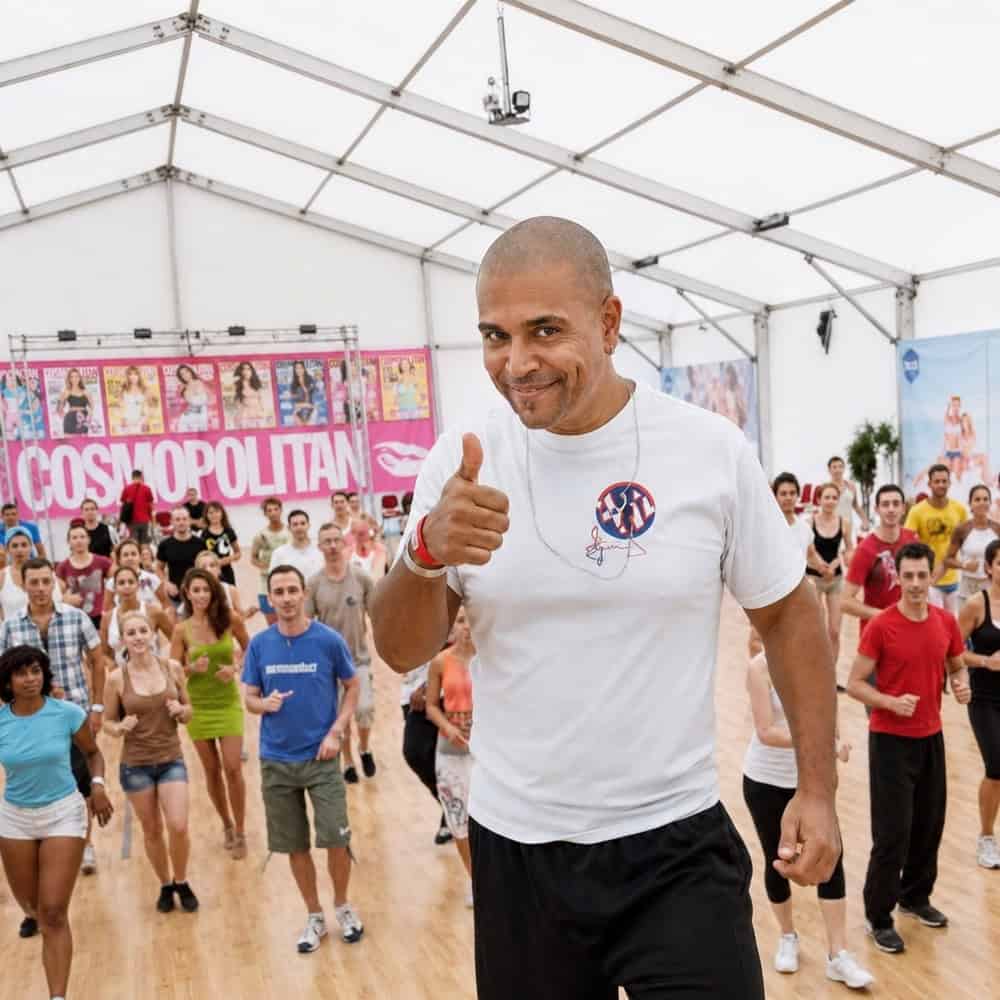
TOMAS GUERRERO and SANTO RICO at a glance
- Stage name: Tomas Guerrero (also written Thomas Guerrero) · school: Santo Rico Dance [1][2]
- Origins and home base: New York 🇺🇸, born to parents from the Dominican Republic; now Orlando, Florida [1]
- Santo Rico: founded in New York in 1995 by Wilton Beltré; Tomas Guerrero is its director [1][3]
- Teams and partners: Wilton Beltré (first teacher), Vitico Pacheco, Amaryllis Cintron (instructor), Candy Mena (Latin Madness), Juan Matos and Osmar Perrones (who came through Santo Rico) [1][3]
- Style: Mambo On2, New York Style · turning technique Santo Rico Spin Technique (1998) [1][2]
- Film: teacher in the HBO documentary El Espíritu de la Salsa (2010) [4]
- Status: director of Santo Rico Florida, in Orlando; new studio announced on his website [1][2]
Tomas Guerrero and Santo Rico: from New York to Florida, a street dancer who became a company director
He is from New York, born to parents from the Dominican Republic. He learned to dance in the street and in clubs, and today he directs Santo Rico in Orlando, Florida.
But Tomas Guerrero did not found Santo Rico: it was founded by Wilton Beltré in 1995. His journey takes him from New York to Florida, and he confirms it himself: “I’m a New Yorker at heart” [1].
About this article
This article follows Tomas Guerrero’s life in chronological order, from New York to Florida, with his own words at every stage. The facts come from his interviews from 2002 to 2024, the press, and Santo Rico’s websites. The numbers in brackets refer to the notes at the bottom of the page.
Last updated: October 2026.
Contents
- True or False: 6 myths about Tomas Guerrero and Santo Rico examined
- New York, early 1990s: merengue, Side Street, and the street
- New York: Vitico, Wilton Beltré, and a team half Dominican, half Puerto Rican
- 1998: the Santo Rico turning technique
- 2000-2003: major stages, Latin Madness, Europe
- March 2004: Spanish Harlem, a studio, and a ten-year lease
- Around 2005: Frankie Martinez, Franklin Diaz, and the body
- 2010: El Espíritu de la Salsa, from Tribeca to HBO
- From New York to Florida: Orlando
- Santo Rico, a school dancers emerge from: Juan Matos, Osmar Perrones
- Eddie Torres, an influence
- His method: foundations, seven turns, theory
- What he says about himself: humility, the street, passion
- In summary: Tomas Guerrero’s journey
- Learning Mambo On2 in Liège and online
- FAQ: all about Tomas Guerrero and Santo Rico
- Sources and bibliography
“Anybody can come from the streets and do this dance well as long as they invest the necessary time and energy that is required.” (Anyone can come from the street and dance this dance well, as long as they invest the necessary time and energy.) — Tomas Guerrero, La Voz del Mambo, page published in June 2012 [1]. That is what the director of Santo Rico says, stating that he has never followed a formal program of Mambo classes.
A New Yorker of Dominican descent, clubs in the Bronx, a company initially made up of Dominicans and Puerto Ricans, a theater show, a turning technique, a documentary on HBO, then Orlando: his journey is quickly summed up. But it is surrounded by phrases that circulate everywhere: founder of Santo Rico, inventor of turns, his documentary.
And there is what those phrases leave out: he is a student of the street who took over a school from its founder. He developed it in his own way, through technique, and today he is taking it forward in Florida.
Founder, inventor, nobody’s student? The 6 MYTHS about TOMAS GUERRERO and SANTO RICO, TRUE or FALSE
Before telling his story, an essential stop. Biographies of Tomas Guerrero circulate through congresses, newspapers, and school websites, copied from one another and sometimes contradicted by the man himself. Six claims keep coming up. Which ones hold up? The verdict at a glance, followed by the details in the sections indicated.
❌ MYTH 1 · Founder of Santo Rico?
Tomas Guerrero supposedly founded Santo Rico
✅ False — it was Wilton Beltré who founded Santo Rico in 1995. Tomas says so himself; so do Juan Matos and Osmar Perrones. The error comes from books and articles. [1][3]
❌ MYTH 2 · The inventor of multiple turns?
He supposedly invented multiple turns
✅ False, and he says so — “Obviously I didn’t develop spinning” (Obviously, I did not invent turns). He created a technique, the Santo Rico Spin Technique, in 1998. [1]
❌ MYTH 3 · Never taken a class?
He supposedly “never took a class”
✅ Needs qualification — he says he has never followed a formal program of Mambo classes (“formal mambo classes like a program”). But he took Afro classes, a Frankie Martinez workshop, and practiced martial arts. [1]
❌ MYTH 4 · “His” HBO documentary?
He supposedly has his own HBO documentary
✅ Needs qualification — he is the teacher in El Espíritu de la Salsa, an HBO film about students at his school. He calls it “our own HBO documentary.” [1][4]
❌ MYTH 5 · A style he created alone?
He is supposedly the inventor of the “Dominican style” of Mambo On2
✅ Not alone — SalsaNewYork credits him in 2002, along with Vittico Pacheco and Osmar Perrones. He mentions Vitico. [1]
❌ MYTH 6 · Dominican or Puerto Rican?
Santo Rico is supposedly a Dominican company
✅ Half and half — the name comes from Santo Domingo and Puerto Rico: the men were Dominican, the women Puerto Rican. [1]
NEW YORK, early 1990s: MERENGUE, SIDE STREET, and the STREET
Tomas Guerrero was born in New York. His parents, who came from the Dominican Republic, live in New York when he is born; they later settle in Florida. He explains this in 2004 [1]. He is the youngest in his family, and “the only mambo dancer in the family” (the only Mambo dancer in the family).
He grows up to the rhythm of merengue, his music [1]. In 2002, he tells how Mambo came along: a friend takes him to Side Street, a club in the Bronx, in the early 1990s, “in an attempt to try something different musically” (to try something different musically). There: “I was introduced to Salsa music (Mambo dancing). The rest, as they say, is history!” (I discovered Salsa music (Mambo dancing). The rest, as they say, is history!) — Tomas Guerrero, SalsaNewYork, July 2002 [1]
The place has never left him: “To me there will never ever be another Side Street.” (For me, there will never be another Side Street.) — Tomas Guerrero, ExploreDance, March 2004 [1]. He remembers an atmosphere that was “so friendly, so rich and welcoming” (so friendly, so rich, and so welcoming) [1].
He learns by watching. In the same interview, he remembers his first girlfriend in the Salsa scene: “my first girlfriend in the salsa scene used to dance with David Melendez’s group” (my first girlfriend in the Salsa scene danced in David Melendez’s group) [1]. She showed him the steps she was learning, and he copied them [1].
Later, he sums up how he learned: “I started dancing in the streets of New York. I used to go to the Palladium in New York, not the old Palladium, but the new Palladium, and all this stuff.” (I started dancing in the streets of New York; I used to go to the Palladium in New York, not the old Palladium but the new one, and all that) — Tomas, Salsa Language, January 2024 [1]. And: “I never was taught any technique.” (I was never taught any technique.) [1]
NEW YORK: VITICO, WILTON BELTRÉ, and a team half Dominican, half Puerto Rican
One day, a friend, Vitico « La Magia » Pacheco, tells him about a team being formed. He tells what happened next in 2024: “One day, my good friend, [Vitico] La Magia, from New York, said, listen, they’re putting together a team.” (One day, my good friend Vitico “La Magia,” from New York, told me: listen, they’re putting together a team.) — Tomas, Salsa Language, January 2024 [1]. Vitico is also the one who introduced him to Wilton: “Vitico Pacheco from the Bronx is also someone who inspired me. He is actually the one who introduced me to Wilton.” (Vitico Pacheco, from the Bronx, is also someone who inspired me. He is the one who introduced me to Wilton.) [1].
The founder’s name is Wilton Beltré. In 1995, in “little Spain” on 160th Street in Manhattan, four dance couples begin the adventure: that is what Tomas Guerrero tells El Especialito in 2000 [1]. The newspaper writes: “gracias a la gran gestión y proyección de Wilton Beltre en el año de 1995 en la “pequeña España” en la 160 de Manhattan e integrado por cuatro parejas de bailarines, se da inicio a la gran trayectoria […] de SANTO RICO DANCE INC.” (thanks to Wilton Beltre’s great work and vision, in 1995, in “little Spain” on Manhattan’s 160th Street, with four dance couples, the great journey of Santo Rico Dance Inc. begins.) [1]. Researcher Juliet McMains, for her part, writes that Wilton Beltré leaves Eddie Torres‘ company to found the Santo Rico school in 1995 [3].
Why that name? “Initially the members of the group, were half from Santo Domingo (Dom. Rep.) and half from Puerto Rico, hence the name Santo Rico.” (Initially, half the members of the group came from Santo Domingo (Dominican Republic) and half from Puerto Rico, hence the name Santo Rico.) — Tomas, SalsaNewYork, July 2002 [1]. He is told: “You know, and the men are from Dominican Republic, the women are Puerto Rican. So come, you’re Dominican, come.” (You know, the men are from the Dominican Republic, the women are Puerto Rican. So come, you’re Dominican, come.) — Tomas, Salsa Language, January 2024 [1]
He starts learning: “I said, okay, cool. So I just started learning Puerto Rican.” (I said: okay, cool. So I simply started learning Puerto Rican (Puerto Rican dance).) [1]. Wilton is his first teacher: “Wilton was my mentor because he brought me in off the streets to learn choreography. But I’ve never taken a class in my life.” (Wilton was my mentor because he brought me off the street to learn choreography. But I have never taken a class in my life.) — Tomas, ExploreDance, March 2004 [1]
At the time, Wilton dances with Brenda Byrd, a well-known New York dancer. Tomas watches him: “he would double and triple spin her very effortlessly and I was very intrigued by that” (he led her through double and triple turns effortlessly, and that intrigued me a great deal) — Tomas Guerrero, La Voz del Mambo [1].
He joins the company “when it was being born” (when it was being born) — Tomas, La Voz del Mambo [1]. Then Wilton can no longer continue running either the company or the school [1]. Tomas describes it this way in 2002: “Wilton (SR’s founder) entrusting me with managing Santo Rico upon his absence” (Wilton (the founder of Santo Rico) entrusted me with managing Santo Rico during his absence) — Tomas, SalsaNewYork, July 2002 [1]. The relationship grows close: “over time Wilton and I became very close” (over time, Wilton and I became very close) [1]. Tomas then directs Santo Rico, starting in the late 1990s [1]. He dates the structure built for his school to that period: “I started this in the late 90s and it was something that I had a vision” (I started this in the late 90s, and it was something I had a vision for) — Tomas, Salsa Language, January 2024 [1].
He had prepared nothing: among his challenges, he mentions “being entrusted with a business I knew nothing about” (being entrusted with a business he knew nothing about) and “the many doubters not believing in my ability to succeed when I took over” (the many doubters who did not believe in his ability to succeed when he took over) [1]. He also mentions losing all the students, and a first studio partly damaged by fire [1].
The Dominican style of Mambo On2, meanwhile, did not come from him alone. The introduction to the SalsaNewYork interview, in 2002, says that he helped create a style of Mambo On2 “along with Vittico Pacheco & Osmar Perrones” (with Vittico Pacheco and Osmar Perrones), which many call the “Dominican Style” [1]. He highlights his friend: “my dear friend Vittico Pacheco, has also had a hand in epitomizing the Dominican way of dancing Mambo” (my dear friend Vittico Pacheco has also helped embody the Dominican way of dancing Mambo) — Tomas, SalsaNewYork, July 2002 [1].
1998: the SANTO RICO turning TECHNIQUE
Tomas does not claim to have invented turns: “Obviously I didn’t develop spinning, but I used these experiences to create a style and technique.” (Obviously, I did not invent turns, but I used these experiences to create a style and a technique.) — Tomas Guerrero, La Voz del Mambo [1]
He describes how he experimented with two female dancers: “through trial and error and process of elimination I learned how to make spinning faster and more fluid” (through trial and error and by elimination, I learned to make turns faster and more fluid). He says he watched female ballet dancers do five to ten turns on one foot [1].
The date is the one he gives in 2024: “that’s how for example in 98 how i came out with my spin technique which which is called the Santo Rico Spin Technique.” (that is how, for example in 98, I came out with my turn technique, which is called the Santo Rico turn technique) — Tomas, Salsa Language, January 2024 [1]. The school’s website confirms: “In 1998, Tomas developed the Santo Rico Spin Technique” (In 1998, Tomas developed the Santo Rico turn technique) [2].
What he wants to bring to it: “And I said to myself, I want to be very technical. And I want people to understand why they move a certain way.” (And I said to myself: I want to be very technical, and I want people to understand why they move a certain way.) [1]
To turn faster, he uses pivots for hand and shoulder controls, and a double pivot [1]. The SalsaNewYork profile, originally published in 2000, calls him New York’s “Spin-miester” and lists his four rules: head up, shoulders following the music, knees bent, weight on the front of the foot [2].
2000-2003: the big STAGES, LATIN MADNESS and EUROPE
In 2000, the newspaper El Especialito introduces Santo Rico Dance Inc.: a studio, instructors, and performances alongside Tito Puente, “recientemente fallecido” (recently deceased), Marc Anthony, José Alberto “El Canario” and Raulín Rosendo [1]. The company marches in the Puerto Rican parade, dances at the Salsa congress at Madison Square Garden and on stages in Puerto Rico [1]. Among the instructors is Amaryllis Cintron, a “pieza fundamental” (key figure) in the turns and feminine styling classes [1].
In April 2001, a show marks a milestone: Latin Madness, at the Heckscher Theatre (5th Avenue, 104th Street), with thirty-eight dancers from New York’s top companies. The numbers are choreographed by the company directors, including Thomas Guerrero for Santo Rico [3]. It is, writes Manny Siverio, the first off-Broadway Mambo theater show [1]. Tomas has a powerful memory of it: “Simply put, it was truly one of the biggest honors of my dancing career.” (In a word, it was truly one of the greatest honors of my dancing career.) — Tomas, SalsaNewYork, July 2002 [1]
He believes it was during this show that he crossed paths with Frankie Martinez, from the Abakua company: “One day, I was doing, I think I was doing a Latin Madness a famous show that we did and I saw Frankie Martinez dancing and I remember we were dancing he was like move your rib cage” (one day, I was doing, I think I was doing Latin Madness, a famous show we did, and I saw Frankie Martinez dancing; I remember, we were dancing, and he told me: move your rib cage) — Tomas, Salsa Language, January 2024 [1]
By 2002, Santo Rico has already performed in England, Norway, Switzerland and Italy; invitations are coming in from Germany, Spain and Sweden. He is the New York contact for the first Salsa congress in the Dominican Republic, in July, and one of the co-producers of the first Salsa Dance Awards [1].
In 2003, he performs Latin Madness again with Candy Mena, at the West Coast Salsa Congress [3]. The trips multiply: “It’s a worldwide thing now. Ever since I started traveling in the early 2000s, I saw the growth everywhere I went.” (it has become worldwide. Since I started traveling in the early 2000s, I have seen growth everywhere I have gone.) — Tomas, Salsa Language, January 2024 [1]
His Mambo style? He sums it up in three words: “Fast, dynamic and unorthodox.” (Fast, dynamic and unorthodox.) — Tomas, SalsaNewYork, July 2002 [1]
MARCH 2004: SPANISH HARLEM, a studio and a ten-year lease
In March 2004, when ExploreDance interviews him, Santo Rico has just left its Washington Heights studio for Spanish Harlem, at 2403 Second Avenue. He explains why: the lease was expiring, and the studio had become too small. He could no longer fit sixty people into the room [1]. He remembers the old place fondly: “I’m Dominican so being in a Dominican community was nice for me.” (I’m Dominican, so being in a Dominican community was nice for me.) — Tomas, ExploreDance, March 2004 [1]
In this more Puerto Rican neighborhood, he wants to welcome everyone. “The music and the dance invites all races, colors, creeds.” (Music and dance invite all races, all colors, all beliefs.) [1]. He signs a ten-year lease: “I signed a 10-year lease” [1].
His daily life fits into one sentence: “I do mambo seven days a week” (I do Mambo seven days a week) — Tomas, ExploreDance, March 2004 [1].
He is direct about what he teaches his students: “People need to know that it’s not about quantity. It’s about quality.” (People need to know that it is not a question of quantity, but of quality.) [1]. And he recalls the origins of the dance: “This dance is a very spiritual dance. It comes from Africa.” (This dance is a very spiritual dance. It comes from Africa.) [1]
AROUND 2005: FRANKIE MARTINEZ, FRANKLIN DIAZ and the body
A body isolation workshop taught by Frankie Martinez in Saint Petersburg, Russia, leaves its mark on him. He dates it approximately: “I was like, this is 2005, something like that.” (I said to myself: this was in 2005, more or less.) — Tomas, Salsa Language, January 2024 [1]
Then he meets Franklin Diaz: “And then I met Franklin Diaz. And then Franklin Diaz told me about learning how to move my hips.” (Then I met Franklin Diaz. And Franklin Diaz told me about learning to move my hips.) [1]
The shock is total: “And I was like, my God, I don’t know how to dance.” (And I said to myself: my God, I don’t know how to dance.) [1]. He then begins to incorporate these ideas. Before that, he had already taken Afro classes while traveling: “and then before that I had started taking some Afro classes, so I was traveling the world and stuff like that” (and before that, I had started taking Afro classes, so I was traveling the world and all that) [1]. In Norway, he notices an excellent Afro teacher [1].
This discovery changes his relationship with dance: “So I became enamored with the Afro culture, and then I started really learning history. And then I was like, oh wow, now I know why we dance, why we dance.” (So I fell in love with Afro culture, then I really started learning history. And then I said to myself: oh, wow, now I know why we dance, why we dance.) [1]
And in his body: “Once I started developing on body movement, my feet were like feathers” (as soon as I developed body movement, my feet became like feathers) [1]. Before that, he says, he danced on his heels [1]. He also takes away this lesson about body weight: on the knees, not on the feet [1].
He also practiced martial arts: “I also did martial arts when I was a teenager” (I also practiced martial arts when I was a teenager) [1].
2010: EL ESPÍRITU DE LA SALSA, from Tribeca to HBO
On April 22, 2010, the film El Espíritu de la Salsa (The Spirit of Salsa) has its world premiere at the Tribeca Festival; HBO airs it in August [4]. It follows students at the Spanish Harlem school, with Tomas Guerrero as their teacher [4].
At the start of the film, he announces: “We’re gonna take these little stories and turn them into success stories” (We are going to take these little stories and turn them into success stories) — Tomas, in the film, according to PopMatters [4]
On NBC New York, he shares his conviction: “anybody can do it. Put in a little work, a little dedication away for maybe an hour or two from your daily lives. Absolutely, you can do it.” (anyone can do it. A little work, a little dedication, an hour or two set aside from your daily life. Absolutely, you can do it.) — Tomas, NBC New York, April 2010 [4]
In 2022, he speaks of it with pride: being “featured in my own HBO documentary” (featured in my own HBO documentary). Yet the film follows his students, and he is their teacher [1][4].
From NEW YORK to FLORIDA: ORLANDO
The SalsaNewYork profile announces it, without a date: Tomas Guerrero now lives and teaches in Orlando, and his studio has moved there [2]. In April 2022, he writes: “here I am in Orlando Florida running my own dance school here” (here I am in Orlando, Florida, running my own dance school) [1].
The move was difficult, he says in January 2024: “It’s very different than New York, I’m a New Yorker at heart.” (It is very different from New York; I’m a New Yorker at heart.) — Tomas, Salsa Language, January 2024 [1]. “So it’s been a difficult transition for me.” (So it has been a difficult transition for me.) [1]
He thought he would keep his approach: “Because of course, you know, I came from New York and I thought, you know, I’m going to have the same approach and the same attitude here.” (Because, of course, I came from New York and thought I would have the same approach and the same attitude here.) [1]. He had to change his pace: “I got to slow down big time.” (I had to slow down a lot.) [1]
He has nevertheless settled in: “You know, I would just renewed our lease for another five years, so I’m going to be here for another little while.” (I have just renewed our lease for another five years, so I’ll be here a while longer.) [1]
He does not give the year he left New York. His website, accessed in October 2026, announces “A New Chapter Is Coming To Orlando” (a new chapter is coming to Orlando) and “New studio. New identity. Same love for the dance.” (New studio. New identity. The same love of dance.), at 7003 Presidents Drive, in Orlando [2].
The studio offers Salsa On2 and Bachata. It builds on the Santo Rico Spin Technique and on a progression through levels, from foundations to advanced [2].
Want to learn Mambo On2?
🎓 Xavier teaches Mambo On2 at Studio24 in Liège. Or online anywhere in the world through Studio Live.
SANTO RICO, a school whose alumni include: JUAN MATOS, OSMAR PERRONES
Many New York dancers pass through Santo Rico. Tomas talks about his large school and “four dance companies” (four companies) [1]. Juan Matos recounts his arrival: “Llegué a la compañía Santo Rico Dance de Nueva York, dirigida por Thomas Guerrero y fundada por Wilton Beltre, y allí me di a conocer en el mundo de la salsa.” (I joined the Santo Rico Dance company in New York, directed by Thomas Guerrero and founded by Wilton Beltre, and that is where I made a name for myself in the world of Salsa.) — Juan Matos, October 2008 interview, published by Cuestión de Baile [3]
Tomas says in turn: “Juan Matos is someone that danced under me and he was apart of my company for a while, but I like what he has developed on his own” (Juan Matos danced under my direction and was part of my company for a while, but I like what he has developed on his own) [1].
Osmar Perrones also spent time there. In a December 2023 interview, he names his three mentors: “yo tuve tres instructores de cabeza, Wilton Beltré, creador de Santo Rico, el creador de Santo Rico, Wilton Beltré” (I had three main instructors: Wilton Beltré, creator of Santo Rico, the creator of Santo Rico, Wilton Beltré) — Osmar Perrones, Diamond Talks, December 2023 [3]. And he adds: “y bailé como tres años en Santo Rico bajo la dirección de [Tomas] Guerrero” (and I danced for about three years at Santo Rico under the direction of Tomas Guerrero) [3]
The SalsaNewYork profile praises these students: “The Santo Rico men are known for being effectively strong leaders, while the women have developed a reputation for being dance floor Spinning Queens” (the men of Santo Rico are known as effective, strong leads, and the women as queens of turns on the dance floor) [2]. The magazine named Tomas’s Saturday partnerwork class the best partnerwork class in New York.
And he still sees his troupe the same way: “My dance company is my baby and I am very proud of them” (My dance company is my baby, and I am very proud of them) — Tomas Guerrero, La Voz del Mambo [1]
EDDIE TORRES, an INFLUENCE
Tomas Guerrero did not learn Mambo from Eddie Torres, but he sees him as a benchmark: “Eddie Torres is also very inspirational because of all his accomplishments and most importantly his longevity. His footsteps are the ones that I model after.” (Eddie Torres is also a great source of inspiration, for everything he has accomplished and especially for his longevity. His footsteps are the ones I take as my model.) — Tomas, La Voz del Mambo [1]
In 2024, he places him at the center of the New York scene: “Eddie Torres was the main man in New York, who of course was a huge influence to all of us” (Eddie Torres was the main man in New York, a huge influence on all of us) — Tomas, Salsa Language, January 2024 [1]. He adds: “Eddie’s the guru, he’s a [Mambo] king” (Eddie is the guru, he is a king of Mambo) [1].
He also acknowledges his method: “Eddie did it the right way, you know, he created his own band, you know, he created events and all that stuff” (Eddie did it the right way: he created his own band, he created events, and all that) [1]. As for the business side, he feels that part was not taken care of, but he does not hold it against him: “when it came to the business aspect of it that part wasn’t taken care of and I don’t blame it on Eddie” (when it came to the business side, that part was not taken care of, and I do not put the blame on Eddie) [1]. In his view, no one then took over that part of the work.
In 2004, he says he would gladly take one of his classes: “If I had the time and I could take a class from Eddie Torres—absolutely I would do it.” (If I had the time, and if I could take a class from Eddie Torres, I would absolutely do it.) — Tomas, ExploreDance, March 2004 [1]
His METHOD: the FOUNDATIONS, the SEVEN TURNS, the THEORY
To men, he says: “What I tell leads is if you’re going to learn how to dance, learn the foundation.” (What I tell leads: if you want to learn to dance, learn the foundations.) — Tomas, Salsa Language, January 2024 [1]. Then: “Learn the seven main turn patterns.” (Learn the seven main turns.) [1]. The reason: “Because your footwork doesn’t change, what changes is the decoration” (because your footwork does not change; what changes is the decoration) [1]
He advises starting with theory: “I tell everybody: learn the theory of dance first, everything will come easy” (I tell everyone: learn the theory of dance first, everything will come easily) [1]. And: “Increase your IQ of music.” (Increase your musical IQ.) [1]
He wanted to learn about the culture: “I wanted to learn about the culture because I didn’t want to disrespect the culture” (I wanted to learn about the culture because I did not want to disrespect it) [1]. One day, he had an epiphany about the way he danced: “[I] had an epiphany and I was like, wow, I’ve been doing it wrong this whole time” (I had an epiphany and said to myself: wow, I have been doing it wrong from the start) [1]
He remembers his first choreography: “My first choreography that I ever did, okay, was through mistakes from my students” (my very first choreography grew out of my students’ mistakes) [1]. He reversed the direction of the figures, and that became his first class: “I did them opposite direction and I created my first class” (I did them in the other direction and created my first class) [1]
On the subway, while he still had his office job, he imitated the turns: “people would look at me like I was crazy, but it was just my passion” (people looked at me as if I were crazy, but it was just my passion) [1]. He concludes: “Your passion is eventually going to supplant your fear and your intimidation” (your passion will eventually supplant your fear and your intimidation) [1]
To improve, he recommends: “do what I did I used to like dancing with women who were 10 levels higher than me because I used to like to know what it actually felt like and that helped me a lot” (do as I did: I liked dancing with women ten levels above me to know what it really felt like, and that helped me a lot) [1]
Of his school today, he says: “the one thing that I pride in myself as far as having my own school is having a school that offers pretty much all of the different aspects” (what I am proud of about my school is that it offers pretty much every aspect of dance) [1].
What he says about HIMSELF: humility, the street, passion
He owes his journey to Salsa: “Salsa kind of choose me” (Salsa somehow chose me) — Tomas Guerrero, La Voz del Mambo [1]. He says this without any classical dance training: “I don’t have a dance background or resume in jazz, ballet or other types of dance” (I have neither training nor a resume in jazz, ballet, or other types of dance) [1].
That lack made him work harder: “So investing the time is what I’m most proud of because not having that extensive dance background made me work even harder.” (Investing time is what I am most proud of, because not having that extensive training made me work even harder.) [1]
The word “work” is not his: “I’ve never called what I do “work” because I live my best life daily doing what I love.” (I have never called what I do “work,” because I live my best life every day doing what I love.) — Tomas Guerrero, OrlandoVoyager, April 2022 [1]
His advice: “The advice that I would like to give to everyone is to stay humble.” (The advice I would like to give everyone is to stay humble.) — Tomas, La Voz del Mambo [1]. And a wish for the community: “I would like to see a lot more respect and harmony amongst dancers in New York and beyond so that we can keep this dance going.” (I would like to see much more respect and harmony among dancers, in New York and beyond, so that we can keep this dance alive.) [1]
In 2024, he points out what the dance has become: “So that’s why it no longer belongs to us, because a lot of them do it better than we do.” (That is why it no longer belongs to us, because many people dance it better than we do.) — Tomas, Salsa Language, January 2024 [1]
As for the number of his travels, he mentions “50 countries” in 2022 [1]; the school’s website states “45+ countries” across six continents [2]. Both figures are their own.
In SUMMARY: Tomas Guerrero’s journey
Eight milestones mark his journey.
- Who: a New Yorker of Dominican descent, a self-taught dancer, director of Santo Rico [1].
- Early 1990s: merengue, then Side Street, in the Bronx [1].
- 1995: Wilton Beltré founds Santo Rico [1][3].
- 1998: the Santo Rico turn technique [1].
- April 2001: Latin Madness, at the Heckscher Theatre [3].
- March 2004: the Spanish Harlem studio [1].
- 2010: teacher in El Espíritu de la Salsa (Tribeca, then HBO) [4].
- Today: Santo Rico in Orlando, Florida [1].
Learning MAMBO On2 in Liège and online
The Mambo that Tomas Guerrero has shaped is danced “on 2,” like New York Style. This is the family taught by Xavier Colina at Studio24, trained in the lineage of Eddie Torres → Adolfo Indacochea.
In Liège, Mambo On2 is danced on Mondays: Introduction at 6:30 pm, Basics+ at 7:30 pm, Intermediate at 8:30 pm. After about a year of practice, it is time for the Advanced level on Thursdays at 6:30 pm. Everywhere else, Studio Live offers video classes to follow at your own pace.
Want to dance Mambo On2?
🎓 Xavier teaches Mambo On2 at Studio24 in Liège. Or online anywhere in the world through Studio Live.
FAQ: everything about TOMAS GUERRERO and SANTO RICO
🌎 Who is TOMAS GUERRERO?
Tomas Guerrero is a Mambo dancer and teacher, born in New York to Dominican parents. He runs Santo Rico, first in New York, now in Orlando, Florida. He learned on the street and in clubs, without a formal program of Mambo classes [1].
✍️ Tomas or Thomas Guerrero?
Both spellings circulate. The press and directories long used Thomas; he signs his name Tomas, as on his website [1][2].
🏛️ Who founded SANTO RICO?
Wilton Beltré, in 1995, in New York. Tomas Guerrero is its director: Juan Matos writes “dirigida por Thomas Guerrero y fundada por Wilton Beltre.” Texts that describe Tomas as the founder are mistaken [1][3].
🌀 What is the SANTO RICO SPIN TECHNIQUE?
It is the turn technique he developed in 1998: pivots for hand and shoulder controls, a double pivot, to turn faster and more smoothly. He makes it clear that he did not invent turns [1][2].
🎬 What is his connection to EL ESPÍRITU DE LA SALSA?
He is the teacher in the documentary. The film, presented at Tribeca in April 2010 and later broadcast by HBO, follows students from his school [4].
🇩🇴 Why “SANTO RICO”?
Because half the group was from Santo Domingo and half from Puerto Rico: the men were Dominican, the women Puerto Rican [1].
🌴 Why did he move from New York to Florida?
He gives neither the year nor the reason. He only says that the transition was difficult, that he is “a New Yorker at heart” and that he had to slow down [1].
📍 Where can you find him?
In Orlando, at Santo Rico Dance Studio, 7003 Presidents Drive, Suite 700. The studio offers Salsa On2 and Bachata [2].
🤝 Who has been part of Santo Rico?
Juan Matos (a dancer in the company for a time) and Osmar Perrones (about three years under Tomas’s direction) [1][3].
🎓 Want to dance MAMBO On2? Where do you start?
With the foundations — that is where everything is decided. Xavier Colina teaches Mambo On2 at Studio24 Liège. In Liège: first trial class for 10€, no reservation needed. Just starting out? Come on Monday at 6:30 pm for Introduction. Then Basics+ at 7:30 pm and Intermediate at 8:30 pm. On Thursday, the Advanced level includes Mambo On2 at 6:30 pm. Practice in the evening at Puerto Rico Nights. Worldwide: Studio Live — +300 HD lessons, 7-day free trial.

About the author
Xavier Colina teaches Salsa On1, Mambo On2, and Bachata at Studio24 in Liège (Belgium) and online through Studio Live. Trained in the direct lineage of Eddie Torres → Adolfo Indacochea (World Mastery program), Fernando Sosa and Korke y Judith. Learn more →
Sources & Bibliography
- ↩
Tomas Guerrero speaks: interviews and press (2000-2024) :
SALSA LANGUAGE, 2024. Interview with the Owner of Santo Rico Dance, Tomas Guerrero [online]. Salsa Language, January 28, 2024. Available at: https://youtu.be/Z-zeHFk3ric [accessed October 25, 2026]. Note: an interview hosted by a student at his school; only Tomas’s statements are included. Some podcast platforms list the date as June 16, 2024; the YouTube video date is used, and the host still refers to “January so far.” The translations are by the author. Excerpts [00:28], [01:29], [04:00], [10:01], [10:07], [10:15], [10:24], [11:47], [12:07], [13:01], [13:08], [13:14], [13:17], [14:05], [14:20], [14:31], [14:37], [14:43], [14:50], [14:59], [15:12], [16:21], [17:28], [18:10], [18:30], [18:41], [19:12], [20:11], [20:43], [24:14], [24:23], [24:29], [25:53], [27:51], [28:19], [28:47], [29:17], [29:34], [35:51], [37:01], [37:50], [37:55], [38:01], [38:15], [38:24].
CLARK, Andrea Dawn, 2004. An Interview with Thomas Guerrero, Director of Santo Rico Dance Inc. ExploreDance.com [online]. March 29, 2004. Available at: https://www.exploredance.com/santorico032904.html [accessed October 25, 2026]. Note: interview conducted at the time of the Spanish Harlem studio opening.
SIVERIO, Manny, 2002. Cyber-Interview of the Month: Thomas Guerrero. SalsaNewYork [online]. July 2002. Available at: https://www.salsanewyork.com/magazine/articles/interview_thomas_guerrero.htm [accessed October 25, 2026]. Note: the introduction is by Manny Siverio; the answers are by Tomas Guerrero.
LA VOZ DEL MAMBO, 2012. An Interview with Thomas Guerrero – New York [online]. Page published June 1, 2012. Available at: https://www.lavozdelmambo.com/dancers/thomas-guerrero-interview/ [accessed October 25, 2026]. Note: the date of the interview itself is not given; this is the date of the page. In it, he dates the start of his professional career to 1995, says that the group “materialized itself in 1996” and refers to “two years” spent in the company before Wilton could no longer lead it. The name is written as “Thomas” and, on one occasion, “Brenda Bryd.”
ORLANDOVOYAGER, 2022. Daily Inspiration: Meet Tomas Guerrero [online]. April 12, 2022. Available at: https://orlandovoyager.com/interview/daily-inspiration-meet-tomas-guerrero/ [accessed October 25, 2026]. Note: questions and answers written in the first person by Tomas Guerrero. In them, he dates the start of his professional career to 1996 and his taking over the leadership of Santo Rico to 1997. Tomas Guerrero’s accounts of his beginnings (1995 or 1996) and his leadership (“after two years,” 1997, or “late 90s” in the Salsa Language interview [18:10]) are not identical; the text uses the late 1990s, the only period that encompasses them all.
CEDEÑO, Wagner, 2000. Santo Rico Dance Inc. El Especialito (Jackson Heights), June 30-July 6, 2000, reproduced on SalsaNewYork [online]. Available at: https://www.salsanewyork.com/magazine/articles/thomas_guerrero_el_especialito.htm [accessed October 25, 2026]. Note: a press article reporting what Tomas Guerrero tells the journalist; the newspaper dates the founding of Santo Rico by Wilton Beltré to 1995. - ↩
The Santo Rico website and the SalsaNewYork profile :
SANTO RICO DANCE STUDIO. About Us [online]. Available at: https://santoricodance.com/about-us [accessed October 25, 2026]. Note: the website says “45+ countries”; Tomas Guerrero says “50 countries” in 2022: both figures are their own.
SANTO RICO DANCE STUDIO. Home [online]. Available at: https://santoricodance.com/ [accessed October 25, 2026].
SALSANEWYORK. Thomas Guerrero (instructor profile) [online]. Available at: https://www.salsanewyork.com/magazine/instructors/thomas_guerrero.htm [accessed October 25, 2026]. Note: profile written by Manny Siverio, originally published in 2000 and later updated; the last line states that Tomas Guerrero lives and teaches in Orlando, with no date. - ↩
Wilton Beltré and the founding of Santo Rico :
McMAINS, Juliet, 2015. Spinning Mambo into Salsa: Caribbean Dance in Global Commerce. New York: Oxford University Press, 2015, chs. 2 and 8. Note: in chapter 2, the passage about Wilton Beltré, who leaves Eddie Torres’s company to found the Santo Rico school in 1995; in chapter 8, the passage about the show Latin Madness (April 2001); page numbers were not recorded.
DIAMOND TALKS, 2023. « Me cansé de esto »: La confesión de Osmar Perrones [online]. Diamond Talks, December 19, 2023. Available at: https://youtu.be/8Ze_Rm8Sjgs [accessed October 25, 2026]. Note: interview with Osmar Perrones. Excerpts [04:39], [06:09].
CUESTIÓN DE BAILE, 2011. Juan Matos [online]. April 7, 2011. Available at: https://cuestiondebaile.wordpress.com/2011/04/07/juan-matos/ [accessed October 25, 2026]. Note: interview with Juan Matos from October 6, 2008, published by the blog in April 2011; the blog writes “Thomas Guerrero” and “Wilton Beltre.”
DIAZ, Rossy, 2014. Dancing Salsa in Santo Domingo, Dominican Republic: A First Look. In: HUTCHINSON, Sydney (ed.), Salsa World: A Global Dance in Local Contexts. Philadelphia: Temple University Press, 2014, ch. 9. Note: the passage states that Tomas Guerrero “founded the New York dance group Santo Rico over a decade ago”: this is the error corrected above. Page numbers were not recorded.
THE DANCER SCENE, 2025. Santo Rico Dance Studio in Orlando [online]. May 19, 2025. Available at: https://www.dancerscene.com/post/santo-rico-dance-studio-in-orlando [accessed October 25, 2026]. Note: the article says “Established in 1995 in New York by Tomas Guerrero”: this is the same error. It also gives the address 945 N. Semoran Blvd for the Orlando studio, which differs from the one on the website. - ↩
El Espíritu de la Salsa :
BAQUERO, Lynda, 2010. The Spirit of Salsa Alive in Harlem, Tribeca. NBC New York [online]. April 22, 2010. Available at: https://www.nbcnewyork.com/news/local/feel-the-spirit-of-salsa-tonight/1911277/ [accessed October 25, 2026].
FUCHS, Cynthia, 2010. El Espiritu De La Salsa (The Spirit of Salsa). PopMatters [online]. August 9, 2010. Available at: https://www.popmatters.com/129390-el-espiritu-de-la-salsa-the-spirit-of-salsa-2496155016.html [accessed October 25, 2026]. Note: a review of the film, announcing its broadcast on HBO on August 9, 2010.
Want to DANCE Mambo On2? Take the first step!
+1500 students have been here before you. Even those who swore they had “two left feet.” We’re waiting for you 💃
🎁 Give a gift voucher · 📱 Learn online · 📖 Blog & articles