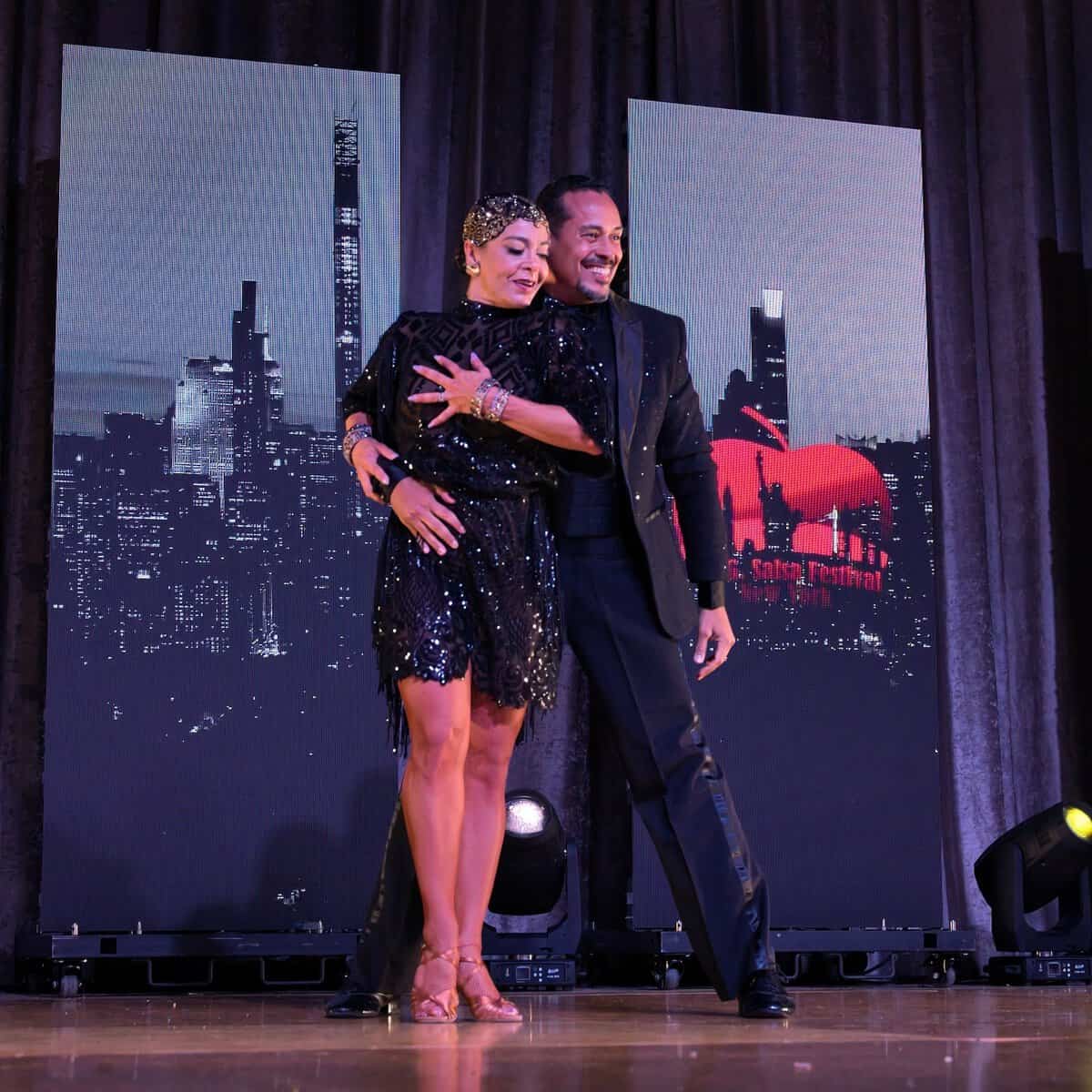
TITO ORTOS and TAMARA LIVOLSI at a glance
- Stage names : “Tito & Tamara”; Tito Ortos, and Flavia Tamara Livolsi, known as Tamara [1]
- Origins : Tito, from Puerto Rico 🇵🇷 · Tamara, born in Argentina 🇦🇷, a dancer in Puerto Rico [2]
- Age : we do not publish it
- Home base : San Juan, Puerto Rico [3]
- Stage partners : Tito: Tania, in Papito Jala Jala’s troupe, then Vanessa Millán, then Tamara · Tamara: a dancer for artists, then Tito [3][4]
- Status : married, they dance and choreograph together [4]
- Style : stage Salsa, drawing on jazz, ballet, and hip-hop [5]
- Choreographers for : Gilberto Santa Rosa, Víctor Manuelle, El Gran Combo [4]
- Congresses : Tito since 1997, the duo since 2000 or 2001 · judges and members of rules committees [4]
- Competition record : no world title claimed in their interviews; Tito does not describe himself as a competitive dancer [4]
- Today : Tito heads a recreation and sports department; Tamara, a dance teacher in a Bad Bunny music video [3]
- Instagram : @titoortos · @flaviatamaralivolsi
Tito Ortos and Tamara Livolsi: “Tito & Tamara,” two worlds of dance brought together in Puerto Rico
Tito Ortos and Flavia Tamara Livolsi, known as Tamara, make up the duo “Tito & Tamara” in Puerto Rico. He comes from music and Papito Jala Jala’s troupe; she comes from commercial dance. They are married and are also choreographers for artists, judges, and teachers.
Their backgrounds are very different, and that is what gives the duo its strength. They have told their own story in many interviews, from 2019 to 2026, with one recurring phrase: dance has given them everything.
About this article
This article first follows Tito Ortos’s journey, then Tamara Livolsi’s, before turning to their first meeting and their shared story, using their own words at each stage. The facts come from their interviews and an academic book. The numbers in brackets refer to the notes at the bottom of the page.
Last updated: October 2026.
Contents
- True or False: examining the 8 myths about Tito Ortos and Tamara Livolsi
- Puerto Rico: a family of musicians and a voice that sounded worse than the feet
- San Juan, early 1990s: Papito Jala Jala and the troupe
- University: pole vaulting and biology
- New York, 1997: six months to study dance
- San Juan, 1998: a Salsa program for the whole community
- Puerto Rico: Tamara, ballet, hip-hop, and touring
- Puerto Rico, 1997: a first meeting in the dressing rooms
- 2001-2002: from a substitute to a stage duo
- Congresses: 1997, 2000, the judging panel, and the rules
- Choreographers for artists: Gilberto Santa Rosa, Víctor Manuelle, and the Gran Combo
- The history of Salsa: University of Salsa and lectures
- Today: Bad Bunny, Guaynabo, and new projects
- How they work: two worlds, arguments, and a step back
- What they say about themselves: passion and gratitude
- In summary: Tito Ortos and Tamara Livolsi
- Studio24’s artistic references
- Learning Salsa and Mambo in Liège and online
- FAQ: all about Tito Ortos and Tamara Livolsi
- Sources and bibliography
“Y yo siempre digo que los pies sonaron mejor que la voz y entonces me quedé bailando.” (And I always say that my feet sounded better than my voice, so I kept dancing.) That is what Tito Ortos says in a Radio Que Rico interview posted online in October 2026 [4]. This sentence sums up the start of his journey: a son of musicians who stayed with dance.
By his side, Tamara comes from another world: ballet, hip-hop, touring with singers. Together, they have learned to dance, choreograph, and travel from congress to congress. Their story is easily summed up, but it is surrounded by phrases that circulate on festival websites: world champions, congresses since 1997, meeting at a commercial audition.
Then there is what those phrases leave out: the music Tito comes from, the commercial dance Tamara comes from, and what each had to learn from the other. That is the thread of this article.
World champions, congresses since 1997, a meeting at an audition? The 8 MYTHS about TITO ORTOS and TAMARA LIVOLSI, TRUE or FALSE
Before telling their story, a necessary stop. Biographies of Tito Ortos and Tamara Livolsi circulate on festival websites and in directories, copied, embellished, and sometimes false. Eight claims keep coming up. Which ones hold up? The verdict at a glance, followed by the details in the indicated sections. As for their age, we do not publish it.
❌ MYTH 1 · Tito Ortos, a dancer with Papito Jala Jala?
Tito Ortos is said to have started as a dancer with Papito Jala Jala
✅ True, but incomplete — he first comes from music: his father’s orchestra, singing lessons, then dance.
❌ MYTH 2 · Tamara, a lifelong Salsa dancer?
Tamara Livolsi is said to have always danced Salsa
✅ False — she comes from commercial dance (ballet, jazz, hip-hop) and learns Salsa onstage with Tito.
❌ MYTH 3 · World champions?
Tito and Tamara are said to be world champions
✅ Not claimed — they do not call themselves world champions in any of their interviews, and Tito does not describe himself as a competitive dancer: he only mentions a few occasional appearances. They are judges and have helped write competition rules.
❌ MYTH 4 · A meeting at a commercial audition?
They are said to have met at an audition for a beer commercial
✅ False — they worked on the same campaign, but in different years. Tamara dates their first meeting to 1997, in the dressing rooms at a concert.
❌ MYTH 5 · Congresses since 1997?
Tito and Tamara are said to have been attending congresses since 1997
✅ Needs qualification — congresses began in 1997 in Puerto Rico, and Tito was involved from the start. The duo, however, has been there since 2000 or 2001.
❌ MYTH 6 · “Tito,” a first name?
Tito is said to be his real first name
✅ Not quite — “Tito” is his family nickname; “Ortos” is the name he was known by at school.
❌ MYTH 7 · Tito and Tamara in Bad Bunny’s music video?
Tito and Tamara are said to dance in the “Baile Inolvidable” music video
✅ False — Tamara prepares the movements behind the scenes, then plays the dance teacher. Tito was not involved in that video.
❌ MYTH 8 · Tamara, Puerto Rican by birth?
Tamara Livolsi is said to have been born in Puerto Rico
✅ No — she herself says she was born in Argentina. She dances and teaches in Puerto Rico.
PUERTO RICO: a family of MUSICIANS and a voice that sounded worse than the FEET
Tito Ortos is born into a family where everyone plays music: “Mis padres ambos son músicos, tengo una familia de músicos, de mis padres, mi madre, mis abuelos, mis bisabuelos, todos son músicos” (My parents are both musicians, I have a family of musicians: my parents, my mother, my grandparents, my great-grandparents, they are all musicians) — Tito, Radio Que Rico, October 2026 [4]. He embraces this with gratitude: “Fui muy, muy bendecido con esta carrera que empezó con una iniciativa de mis padres.” (I have been very, very blessed with this career, which began with an initiative from my parents.) [4]
His name is a story in itself. “Realmente Tito es mi apodo. Todo el mundo en mi familia me conoce como Tito” (Actually, Tito is my nickname. Everyone in my family knows me as Tito) — Tito, No Puedo Tengo Ensayo TV, November 2019. As for Ortos: “todos los de la escuela siempre me conocían por Ortos” (everyone at school always knew me by the name Ortos) [3].
He learns to play several instruments: “Pero también aprendí a tocar dos o tres instrumentos como el bajo, el clarinete, la guitarra.” (But I also learned to play two or three instruments, like the bass, the clarinet, the guitar.) [4]. His father leads an orchestra, De Menor a Mayor : “me quiso hacer una orquesta de menor a mayor” (he wanted to put together an orchestra for me, De Menor a Mayor) [4]. To have him sing and dance in the orchestra, he enrolls him in classes: “me dijo, no, yo te voy a meter aquí a coger las clases de baile y para que estés en la orquesta cantando.” (he told me: no, I am going to put you here to take dance classes, and so you can be in the orchestra singing.) [3]
The orchestra records two albums “nosotros hicimos dos discos” (we made two records) [3]. But in the end, “los pies sonaron mejor que la voz y entonces me quedé bailando” (the feet sounded better than the voice, so I kept dancing) [4]. His dance teacher is named Papito Jala Jala: “donde mi maestro realmente donde el señor Papito Jalajala” (with my teacher, really, with Mr. Papito Jalajala) [4].
SAN JUAN, early 1990s: PAPITO JALA JALA and the troupe
Papito Jala Jala owes his nickname to a televised competition featuring Jala Jala by El Gran Combo [4]. His troupe tours with the island’s Salsa orchestras: “fue un grupo que tenía casi el monopolio de todos los conciertos” (it was a group that had almost a monopoly on all the concerts) — Tito, Hablandoconchupy, April 2024 [3]. It is also “el primer grupo que representó a Puerto Rico especialmente en Europa, en Italia” (the first group that represented Puerto Rico, especially in Europe, in Italy) [3].
Tito joins in the early 1990s, according to Juliet McMains’s book [5]. He makes his debut with him at Roberto Roena concerts: “Papito me me invita para pertenecer a su grupo para hacer unas presentaciones con Roberto Roena y pues por ahí empezó mi carrera de bailarín” (Papito invites me to join his group for performances with Roberto Roena, and that is where my career as a dancer began) [3]. A dancer was missing: “Hasta que un día él me vio y pasaron varias semanas y había un concierto, que me faltó un bailarín” (Until one day he saw me, and several weeks passed, and there was a concert for which I was short one dancer) [3].
He names the dancers in the troupe: “grandes bailarines como Felipe Polanco, Tania Santiago, para ese tiempo estaban Ángel Martínez, Ingrid” (great dancers like Felipe Polanco, Tania Santiago; at that time there were Ángel Martínez, Ingrid) [4]. Tania is his partner at the time: “tania que era mi pareja que la que me estaba ayudando todo el tiempo en las cosas de pareja” (Tania, who was my partner, the one who helped me all the time with partner (dance) work) [4].
His first trip as a dancer, in 1994, takes him to Cuba with Papito and his group [4]. Tours in Italy follow in the 1990s [4].
On2 comes to the troupe late. According to Tito, as reported by McMains, “it was only after instruction from legendary Palladium dancer Anibal Vazquez and Eddie Torres dancer Stacey Lopez, both of whom had perfected their styles in New York, that Papito Jala Jala’s dancers learned to dance on-2” (it was only after instruction from legendary Palladium dancer Aníbal Vázquez and Eddie Torres dancer Stacey López, who had perfected their styles in New York, that Papito Jala Jala’s dancers learned to dance On2) [5].
Stacy López later notices him in an exhibition with Papito and takes him to work for RMM artists at Madison Square Garden [4]. He also dances for Fania, then at Radio City Music Hall, during a tribute to the Beatles featuring, among others, Celia Cruz [4].
UNIVERSITY: POLE VAULTING and biology
During those years, Tito is also an athlete: “hice todos mis años de salto con pértiga hasta que me gradué” (I did pole vaulting all those years until I graduated) [3]. He has an athletic scholarship: “Obviamente tenía una beca por deporte y ahí me quedé ya, solté el baloncesto” (Obviously I had an athletic scholarship, and I stayed there, I gave up basketball) [3]. He graduates with a degree in biology [3].
Sports feed into his dancing: “yo siempre he sido una persona muy apasionada con el deporte, pues eso mismo lo apliqué.” (I have always been someone very passionate about sports, so I applied that to dance.) — Tito, Radio Que Rico, October 2026 [4]. And he is grateful: “tengo que agradecerle muchísimo a los años que hice el deporte” (I owe a great deal of thanks to the years I spent playing sports) [3].
NEW YORK, 1997: six months to study DANCE
In 1997, Tito finishes university: “el 97 me gradué de la universidad y yo me voy a estudiar a New York solamente baile” (in 97 I graduate from university and go to New York to study only dance) [3]. There he takes classes in jazz, ballet, tap, and acrobatics: “me fui a entrenar en otras disciplinas, en ballet, en jazz, en tap, en acrobacia” (I went to train in other disciplines, in ballet, in jazz, in tap, in acrobatics) [4].
McMains explains that he pays for those six months at the Broadway Dance Center with money from a television commercial [5]. To make his classes less expensive, he cleans the studio: “todos los días limpiaba los pisos y los baños” (every day, I cleaned the floors and the restrooms) — Tito, No Puedo Tengo Ensayo TV, November 2019 [3]. His goal: “I wasn’t looking to be a jazz or ballet dancer. I was looking forward to be a better salsa dancer.” (I wasn’t trying to become a jazz or ballet dancer. I was trying to become a better Salsa dancer.) [5]. He comes away with a conviction: social Salsa “it don’t prepare you to do shows or be a stage performer or do a great choreography” (doesn’t prepare you to do shows, be a stage performer, or create a great choreography) [5].
SAN JUAN, 1998: a SALSA program for the whole community
On his return, Tito works for a time as a pharmaceutical sales representative, then begins to structure his teaching in a gym [3]. He had already taught a few classes while traveling with Papito, he says, but did not yet consider himself a teacher [3]. In 1998, the municipality of San Juan opens a program to him: “en el 98 pude tener la oportunidad de empezar con el programa del municipio de San Juan” (in 98 I had the opportunity to start with the municipality of San Juan’s program) [3]. The director knew him as an athlete: “they gave me the opportunity because the director know me as an athlete” (they gave me the opportunity because the director knew me as an athlete) [4].
This program is free: “I started developing a program with the government of Puerto Rico of teachings such for free for all the community” (I started developing a program with the government of Puerto Rico, lessons, free for the whole community) — Tito, Aventura Dance Cruise, April 2019 [4]. He says he registered his teaching method: “I went to the State of the Department of Puerto Rico, registered that method of teaching.” (I went to the Department of State of Puerto Rico and registered that teaching method.) [4]. It continues, he says, in San Juan and Bayamón [3].
PUERTO RICO: TAMARA, BALLET, HIP-HOP, and touring
Tamara starts in commercial dance: “Well, I started out in commercial dance, hip-hop, jazz, after many years of training in ballet.” (Well, I started in commercial dance, hip-hop, and jazz, after many years of ballet training.) — Tamara, elSol festival, May 2020 [2]. She was born in Argentina, she says: her first international tour, with Puerto Rican pop singer Wilkins, takes her back there, “to argentina ironically where I was born” (to Argentina, ironically where I was born) [2].
Ballet was not her goal: “yo entrené muchos años en muchas otras disciplinas, empezando por el ballet, pero no era ni mi meta, ni mi pasión, ni nada” (I worked for many years in many other disciplines, starting with ballet, but it was neither my goal, nor my passion, nor anything) [3]. Her first professional opportunity comes from the director of a commercial dance school: “estaré eternamente agradecida con ese hombre” (I will be eternally grateful to that man) [3]. Her first job is with a rapper: “oportunidad de bailar con un artista de rap de los 90” (opportunity to dance with a rap artist from the 90s) [2].
She then goes on tour with singers such as Manny Manuel and later Luis Fonsi [2]. In 1998, she starts dancing with Víctor Manuelle: “yo en el 98 empiezo a bailar con” (I, in 98, start dancing with) — even before knowing how to dance Salsa: “I started dancing with Victor even before I know how to dance salsa” (I started dancing with Víctor even before I knew how to dance Salsa) [2].
PUERTO RICO, 1997: a first meeting in the DRESSING ROOMS
The two worlds first cross through advertising. Tito talks about Virazón: “un anuncio publicitario que se hizo aquí una campaña bien grande que se hacía con la cervecera Budweiser que se llama el Virazón y era un concurso de baile” (an advertisement made here, a very big campaign with the Budweiser brewery, called Virazón, and it was a dance contest) — Tito, Mambo On Fire, October 2020 [4]. He auditions in the campaign’s final year: “primer trabajo que yo fui a audicionar que hice fuera de la salsa” (first job I went to audition for, that I did outside Salsa) [4]. Tamara, for her part, “también había pertenecido unos años antes” (had also been part [of the campaign] a few years earlier) [4].
For her, the meeting did not take place at the audition: that year, she says, she had nothing to do with the campaign [3]. Her first meeting with him dates back to 1997, in the dressing rooms at a concert: “lo reconozco ya estaba pasando por los pasillos de los camerinos para tarima” (I recognize him, I was already walking through the dressing room corridors, toward the stage) — Tamara, Franco Rocha, June 2020 [2]. She adds: “eso fue el 97” (that was in 97) [2].
They then lose touch. In late 1999, Tamara injures her knee. Tito helps her, then calls her a month later: “genuinamente yo la ayudé y después que pasaron un mes de eso yo la llamé para preguntar cómo ella estaba” (I sincerely helped her, and a month later I called her to find out how she was doing) — Tito, No Puedo Tengo Ensayo TV, November 2019 [3]. Tamara tells this story twice, with differing details. In her interview with Franco Rocha, she spends December 31, 1999 “sentada frente al televisor con un yeso en la rodilla” (sitting in front of the television with a cast on her knee); the call comes later, “no me acuerdo cuánto tiempo después” (I don’t remember how much later), as she waits outside a closed doctor’s office [2]. In the November 2019 interview, she places the call on December 31 itself, just after the cast was removed, also outside a closed office [3]. Then nothing more: “no supe más de él hasta abril del 2000 que empecé a bailar en el grupo de Ángel Martínez y ahí él era uno de los bailarines en rotación” (I didn’t hear from him again until April 2000, when I started dancing in Ángel Martínez’s group, where he was one of the rotating dancers) — Tamara, Franco Rocha, June 2020 [2].
For Tamara, feelings come before the stage: “nosotros empezamos a compartir de manera sentimental antes de la del baile” (we started sharing a romantic connection before dancing) — Tamara, No Puedo Tengo Ensayo TV, November 2019 [3]. Tito places the start of their relationship later: “no pasó como realmente como cuatro años después que empezó nuestra relación realmente ya de una manera personal” (it didn’t really happen until about four years later, when our relationship began, really on a personal level) — Tito, Radio Que Rico, 2026 [4]. When he later asks her to replace his partner for some shows, she is already his romantic partner: “Tamara ya era mi pareja sentimental” (Tamara was already my romantic partner) [4].
2001-2002: from SUBSTITUTE to stage DUO
When Tito starts out as a soloist, he first presents a routine with his first stage partner, Vanessa Millán: “Y yo monté una cosita primero con Vanessa que la presentamos en Italia y después en Chicago y ahí en el 2001 pues nos presentamos” (And I first put together a little routine with Vanessa, which we performed in Italy and then in Chicago, and there, in 2001, we performed) — Tito, No Puedo Tengo Ensayo TV, November 2019 [3]. Tamara names her too: “Vanessa Millán, que era su pareja en aquel momento” (Vanessa Millán, who was his partner at the time) [3].
His partner cannot continue: “pareja no pudo continuar con la que estaba trabajando” (the partner I was working with couldn’t continue) [4]. Tito already has shows booked: “ya yo tenía unas fechas vendidas y le pedí a Tamara que sustituyera que me ayudara en unas fechas que tenía” (I already had shows booked and I asked Tamara to fill in, to help me with some shows I had) [3].
Tamara tells the story with a laugh: “ya hemos hecho el cuento que yo llegué aquí por una encerrona del joven” (we’ve already told the story: I ended up here through a trap set by the young man) — Tamara, No Puedo Tengo Ensayo TV, March 2025 [3]. And she adds: “cuando nosotros empezamos a bailar juntos fue por pura casualidad” (when we started dancing together, it was purely by chance) [3]. Their stage debut together dates to 2002 [3].
For Tamara, the early days are tough: “para mí era un pop quiz constante yo me moría del miedo por muchos años” (for me it was a constant pop quiz, I was scared to death for many years) — Tamara, Hablandoconchupy, April 2024 [3]. Tito acknowledges the difficulty: “al principio fue un poco difícil encontrar esa fórmula entre los dos” (at first, it was a little difficult to find the formula between the two of us) [4].
They are now married. Tito: “Tamara es mi esposa” (Tamara is my wife) [4]. She is also, he says, “mi socia, mi confidente, mi cómplice, así que es realmente mi compañera de vida” (my business partner, my confidante, my accomplice, so truly my life partner) [4]. Tamara: “I get to do this with my husband.” (I do this with my husband.) [2]
The CONGRESSES: 1997, 2000, the judges, and the rules
For Tito, the congresses begin in 1997: “los congresos empezaron en 1997, empezaron aquí en Puerto Rico” (the congresses started in 1997, they started here, in Puerto Rico) — Tito, Radio Que Rico, October 2026 [4]. He is involved from the start: “when the Congress is starting in 1997 I was part of the those first group that start spreading these events around the world” (when the congress starts in 1997, I was part of the first groups that started spreading these events around the world) [4].
With Tamara, it comes later: “con mi esposa desde el 2001, 2000, ya estamos bien inmersos en lo que es los congresos.” (with my wife, since 2001, 2000, we are already deeply immersed in what the congresses are.) [4]. Tamara places her beginnings in 2000: “i started in 2000 in the congress thing” (I started in 2000 in this congress thing) [4]. They even have an annual group, TNT, for the Puerto Rico congress: “TNT, que era un grupo anual, una vez al año, nos reuníamos para el Congreso Puerto Rico.” (TNT, which was an annual group: once a year, we would get together for the Puerto Rico Congress.) — Tamara, March 2025 [3]. It has up to twenty-two dancers [3].
They also have a role in the rules: “desde que más o menos comenzaron muchas de las competencias, nosotros fuimos parte de esos comités para crear muchas de las reglas” (since many competitions more or less began, we have been part of those committees to create many of the rules) [4]. But Tito does not present himself as a competitor. He says: “yo competí en dos cositas de relacionadas al baile” (I took part in two small things related to dance), then clarifies: “yo no competí en el ambiente del baile pero yo toda mi vida competí” (I didn’t compete in the dance world, but I’ve competed all my life) [4]. In the November 2019 interview, there is also mention of just one competition, on the show Sábado Gigante [3]. He has always been athletic.
Among their routines is a tribute to the Palladium. According to McMains, Tito and Tamara created a tribute routine that begins with film clips from the Palladium era, followed by original choreography; they also teach a class at congresses called “Palladium Mambo Essence” [5]. Tito studies this history: “empezando por Mike Ramos uno de los que perteneció a los Mambo Aces” (starting with Mike Ramos, one of those who belonged to the Mambo Aces) [4].
CHOREOGRAPHERS for artists: Gilberto Santa Rosa, Víctor Manuelle, and Gran Combo
The first artists to commission choreography from them are Gilberto Santa Rosa, Víctor Manuelle, and El Gran Combo [4]. Tito: “ellos fueron los primeros que nos abrieron esas grandes oportunidades para yo poderme desarrollar” (they were the first to open up those great opportunities for us so that I could develop) — Tito, Radio Que Rico, October 2026 [4]. La India, Tito Nieves, J Ruiz, Norbe, and Choco follow [4].
Their principle: “lo que nosotros hacemos siempre es un complemento para el show de él” (what we do is always a complement to the artist’s show) — Tito, March 2025 [3]. For a film in the Dirty Dancing series, they audition in Puerto Rico: “Nosotros audicionamos para esa película, gracias a Dios nos escogieron” (We auditioned for that film; thank God they chose us) [4].
The HISTORY of Salsa: University of Salsa and lectures
Tito doesn’t just dance: he teaches history. He dates a project, University of Salsa, to 2004: “Puerto Rico we were sitting and we were saying okay we want to do we started a project called University of Salsa” (In Puerto Rico, we were sitting and saying: okay, we want to do… we started a project called University of Salsa) — Tito, Aventura Dance Cruise, April 2019 [4]. His research never stops: “I have been a quest of mine that hasn’t stopped. Since 2004,” (It’s a quest for me that hasn’t stopped. Since 2004,) [4].
His rule: “Yo cuando hablo sobre estas cosas hablo sobre hechos, no me invento nada” (When I talk about these things, I talk about facts; I don’t make anything up) — Tito, Franco Rocha, April 2020 [4]. Mike Ramos, from the Palladium era, is one of his great mentors on this history [4].
TODAY: Bad Bunny, Guaynabo, and new projects
In an interview posted online in March 2025, Tamara talks about her role in Bad Bunny’s Baile Inolvidable music video: “Y yo, mira, voy a ser de maestra de baile de Benito.” (And me, look, I’m going to be Benito’s dance teacher.) [3]. She first works behind the scenes: “esta vez era yo en un rol que no me ha tocado, que es Behind the Scene” (this time it was me, in a role I hadn’t had before, behind the scenes). Then she plays the dance teacher in the video: “y después en el rol de maestra se me dio bien fácil” (and then, in the role of the teacher, it came very easily to me) [3]. Tito, for his part, wasn’t in the video: “yo no fui para él” (I didn’t go for him) [3]. He’s proud of her: “como su esposo, como su partner de trabajo, pues me emociona que lo haya hecho ella” (as her husband, as her work partner, I’m glad she was the one who did it) [3].
After the San Juan program, Tito changes roles. In 2024, he explains that he was given the opportunity to head the recreation and sports department of the municipality of Guaynabo: “me dieron la oportunidad de ser el director del Departamento de Recreación y Deportes del municipio de Guaynabo” (I was given the opportunity to be the director of the Recreation and Sports Department of the municipality of Guaynabo) — Tito, Hablandoconchupy, April 2024 [3]. In October 2026, he is still talking about this role [4].
Tamara talks about a dance dream come true: “para mí era bailar con Gilberto, dentro de lo que es la salsa” (for me, it was dancing with Gilberto, in the world of Salsa) [3]. It all started with a song by Gilberto Santa Rosa: “esa de Perdóname me enamoré y en algún momento yo quiero poder bailar esa canción” (that one, Perdóname, I fell in love, and I told myself that one day I’d like to be able to dance to that song). The host concludes: “y se te dio” (and it came true) [3]. And another dream, away from the stage: “being able to have an animal shelter doesn’t have to be a big one a small one” (being able to have an animal shelter, not necessarily a big one, a small one) [2].
Want to learn Salsa?
🎓 Xavier teaches Salsa On1 and Mambo On2 at Studio24 in Liège. Or online anywhere in the world through Studio Live.
How they WORK: two worlds, arguments, and a step back
At first, they come from two worlds: “we were polar opposites so of course his forte is the salsa salsa cha-cha and my forte is jazz hip-hop” (we were polar opposites: his strength is obviously Salsa, cha-cha, and mine is jazz, hip-hop) — Tamara, elSol festival, May 2020 [2]. Tito: “at the beginning when we start we came from different backgrounds so it took a while to find that connection and that chemistry between us” (at the beginning, when we started, we came from different backgrounds, so it took a while to find that connection and that chemistry between us) [4].
There are arguments: “it’s up and down, it’s fighting, it’s everything.” (it goes up, it goes down, we argue, that’s all.) [4] Tito admits: “yo a lo mejor era tal vez un poquito más exigente en la idea de lo que yo quería hacer” (I was perhaps a little more demanding about the idea of what I wanted to do) [3]. Then he learns to step back: “encontrar yo también la manera de dar un paso para atrás y decir ahora ella tiene más importancia y tiene más cosas que aportar” (finding a way for me, too, to take a step back and say: now she’s the one who matters more, she has more to contribute) [3].
Today, the work is shared: “todo lo que nosotros hacemos es un trabajo de literalmente de Tito y Tamara o de Tamara y Tito” (everything we do is literally the work of Tito and Tamara, or Tamara and Tito) [3]. Tamara says of him: “nobody can imitate his body movement and probably my faces” (no one can imitate his body movement, and probably my expressions) [2]. She smiles: “a mi esposo no le gusta mucho ensayar” (my husband doesn’t like rehearsing very much) [2].
There has been no shortage of criticism. Tito received it for bringing female dancers from other backgrounds into Salsa: “yo empecé a recibir mucha mucha crítica pero ya yo había empezado a hacer ese crossover” (I started getting a lot, a lot of criticism, but I had already started making that crossover) [3]. Tamara, for her part, admits to a long period of insecurity: “i would take it personally not because i’m not humble but because i was insecure i know i wasn’t at people’s level at salsa” (I took it personally, not because I’m not humble, but because I was insecure: I knew I wasn’t at other people’s level in Salsa) [2].
What they say about themselves: PASSION and GRATITUDE
Tito: “it’s my passion and be able to do what you like and what you are passionate of” (it’s my passion, and being able to do what you love and what you’re passionate about) — Tito, Salsa Language, January 2026 [4]. And: “because I never thought that I this is gonna be my life” (because I had never thought this would be my life) [4].
Puerto Rico remains in his heart: “siempre vamos con nuestra bandera en el pecho, con nuestra isla en el corazón” (we always go with our flag on our chest, with our island in our heart) [4]. He knows he has people around him: “yo he sido súper súper súper bendecido de tener tantas personas muy importantes alrededor mío en mi carrera” (I’ve been super, super, super blessed to have so many very important people around me in my career) [4]. And: “yo vivo súper agradecido de la cosa más pequeña que haya hecho como la más grande” (I live feeling super grateful for the smallest thing I’ve done as well as the biggest) [3].
Tamara: “most of all is the fact that I enjoy my work 24-7.” (above all, the fact that I enjoy my work 24 hours a day.) [2] She loves learning: “me encanta ser estudiante me encanta aprender a bailar me encanta bailar” (I love being a student, I love learning to dance, I love dancing) [2]. Her advice: “find your own identity, find your own signature. Don’t copy, don’t imitate.” (find your own identity, your own signature. Don’t copy, don’t imitate.) [2]
In SUMMARY: Tito Ortos and Tamara Livolsi
Eight milestones mark their story.
- Who: a son of musicians who became a dancer, a dancer from ballet and commercial dance, married to each other.
- Early 1990s: Tito joins Papito Jala Jala’s company [5].
- 1997: six months of dance studies in New York for Tito; first meeting with Tamara, according to her [2][5].
- 1998: a Salsa program in San Juan [3].
- 2001-2002: Tamara replaces Tito’s partner, and the duo is born [3].
- Since 2000 or 2001: congresses [4].
- Judging panels and rules: judges and members of the committees that created many competition rules [4].
- Choreographers for: Gilberto Santa Rosa, Víctor Manuelle, El Gran Combo [4].
- Today: Bad Bunny for Tamara, Guaynabo for Tito [3].
Studio24’s artistic REFERENCES
Tito and Tamara’s paths cross those of masters you’ll find on this blog. Eddie Torres first: one of the dancers who taught On2 to Papito Jala Jala’s company, Stacey López, is an Eddie Torres dancer [5].
Rodrigo Cortazar next: he names Tito Ortos among his masters [6]. Karel Flores finally: she includes Tama Livolsi among the artists who inspire her and whom she calls her friends [6].
Learning SALSA and MAMBO in Liège and online
Tito Ortos and Tamara Livolsi’s Salsa and Mambo draw on the same foundations that Xavier Colina teaches at Studio24: Salsa On1, in the lineage of Fernando Sosa, and Mambo On2, in that of Eddie Torres and Adolfo Indacochea. Whether you’re in Liège or anywhere in the French-speaking world, you can begin that same progression.
In Liège, Salsa On1 is danced on Tuesdays and Mambo On2 on Mondays: each time, Intro at 6:30 pm, Basics+ at 7:30 pm, Intermediate at 8:30 pm. After about a year of practice, it’s time for the Advanced level on Thursdays: Mambo On2 at 6:30 pm, Salsa On1 at 7:30 pm. Everywhere else, Studio Live offers video classes to follow at your own pace.
Want to dance Salsa?
🎓 Xavier teaches Salsa On1 and Mambo On2 at Studio24 in Liège. Or online anywhere in the world through Studio Live.
FAQ: all about TITO ORTOS and TAMARA LIVOLSI
🌎 Who are TITO ORTOS and TAMARA LIVOLSI?
Tito Ortos, from Puerto Rico, is a dancer, choreographer, and teacher; Flavia Tamara Livolsi, known as Tamara, born in Argentina, comes from commercial dance. Married to each other, they form the duo “Tito & Tamara” [1][2][4].
✍️ How do you spell their names?
Tito is the nickname his family gives him; Ortos is the name he was given at school. She introduces herself as Tamara Livolsi in her interviews, and her Instagram account displays Flavia Tamara Livolsi [1][3].
🇵🇷 Did Tito Ortos start with Papito Jala Jala?
Yes, but he first comes from music: his father’s orchestra, singing lessons, then dance. He then joins Papito Jala Jala’s company in the early 1990s [3][4][5].
💃 Has Tamara always danced Salsa?
No. She comes from ballet, jazz, and hip-hop; she learns Salsa onstage with Tito. She says she experienced that period as a constant pop quiz [2][3].
📅 When did they become a duo?
Tito places the start of their stage duo in 2002, after a routine with Vanessa Millán, the partner in his first independent project, in 2001. Tamara says she started at congresses in 2000 [3][4].
🏆 Are they world champions?
They don’t claim any world titles in their interviews. Tito doesn’t present himself as a competitive dancer: he mentions only a few occasional appearances. They are judges and have served on committees that created competition rules [4].
🎭 Where did they meet?
Tamara dates their first meeting to 1997, in the dressing rooms at a concert. Both took part in the Virazón advertising campaign, but in different years [2][4].
🎤 Which artists have they choreographed for?
Gilberto Santa Rosa, Víctor Manuelle, and El Gran Combo first, then La India, Tito Nieves, J Ruiz, Norbe, and Choco [4].
🎶 What is “Palladium Mambo Essence”?
It’s a class Tito and Tamara give at congresses, teaching shines from the Palladium era reconstructed from old films, according to McMains [5].
🎬 Are they in Bad Bunny’s music video?
Tamara prepares the movements behind the scenes, then plays the dance teacher. Tito wasn’t involved in that video [3].
🏛️ What does Tito Ortos do today?
After a Salsa program in San Juan, he says in 2024 that he heads the recreation and sports department of the municipality of Guaynabo [3].
🎂 How OLD are Tito Ortos and Tamara Livolsi?
We don’t publish their ages: this article tells the story of their years in their careers, not their civil status.
🎓 Want to dance SALSA? Where do you start?
In Liège: first trial class for 10€, no reservation needed. Tuesdays are for Salsa On1; Mondays are for Mambo On2: both days offer Introduction at 6:30 pm, Basics+ at 7:30 pm, and Intermediate at 8:30 pm. On Thursdays, the Advanced level (about one year of practice) includes Mambo On2 at 6:30 pm and Salsa On1 at 7:30 pm. Practice in the evening at Puerto Rico Nights. Anywhere in the world: Studio Live — +300 HD lessons, free 7-day trial.

About the author
Xavier Colina teaches Salsa On1, Mambo On2, and Bachata at Studio24 in Liège (Belgium) and online through Studio Live. Trained in the direct lineage of Eddie Torres → Adolfo Indacochea (World Mastery program), Fernando Sosa and Korke y Judith. Learn more →
Sources & Bibliography
- ↩
Official accounts :
TITO ORTOS [Instagram: @titoortos]. Profile. Available at: https://www.instagram.com/titoortos/ [accessed October 25, 2026].
FLAVIA TAMARA LIVOLSI [Instagram: @flaviatamaralivolsi]. Profile. Available at: https://www.instagram.com/flaviatamaralivolsi/ [accessed October 25, 2026]. Note: the account displays “Flavia Tamara Livolsi”; in her interviews, she introduces herself as Tamara Livolsi, and the bio on Tito’s account calls her “Tamara.” - ↩
Tamara Livolsi speaks: interviews (2020) :
ELSOL FESTIVAL, 2020. Interview with Tamara Livolsi [online]. elSol festival, May 14, 2020. Available at: https://www.youtube.com/watch?v=3Mr9Da7uxek [accessed October 25, 2026]. Note: interview in English; excerpts [00:36], [00:53], [03:52], [04:08], [07:37], [18:12], [24:10], [24:56], [28:24], [31:21], [33:24].
FRANCO ROCHA, 2020. De « Tu a Tu » Franco Rocha con Tamara Livolsi [online]. Franco Rocha, June 3, 2020. Available at: https://www.youtube.com/watch?v=G_rNL3r-B_g and https://www.youtube.com/watch?v=epWCMJLE_fk [accessed October 25, 2026]. Note: two shows from the same day, in Spanish; excerpts [31:41], [38:58], [46:48], [47:26] (first) and [05:19], [06:21], [11:34] (second). - ↩
Tito and Tamara speak: interviews (2019-2025) :
NO PUEDO TENGO ENSAYO TV, 2019. Tito Ortos y Tamara Livolsi: « De un favor a embajadores mundiales » [online]. No Puedo Tengo Ensayo TV, November 5, 2019. Available at: https://www.youtube.com/watch?v=zB2qLR2-fDg [accessed October 25, 2026]. Note: interview in Spanish; excerpts [03:34], [03:46], [08:19], [09:05], [11:27], [17:05], [18:10], [20:53], [27:47], [41:47], [42:26], [51:50], [55:09], [55:36], [55:51], [56:42], [59:19], [64:47], [65:12], [66:33], [77:22]. Note: Tamara says her knee was first put in a cast in 1997, during a dance class [57:54], and then a second time; on December 31, she has just had this second cast removed when the call comes [57:44]; Tito places his call a month after that help [56:42].
HABLANDOCONCHUPY, 2024. Hablando con Tito Orto y Tamara Livolsi [online]. Hablandoconchupy, April 24, 2024. Available at: https://www.youtube.com/watch?v=5QN1ZHJF0lo [accessed October 25, 2026]. Note: interview in Spanish; excerpts [01:24], [05:54], [06:20], [06:57], [11:29], [13:15], [13:32], [13:38], [14:55], [20:06].
NO PUEDO TENGO ENSAYO TV, 2025. « La historia de la salsa no se puede contar sin Tito y Tamara » / Video Baile Inolvidable / Legado y más [online]. No Puedo Tengo Ensayo TV, March 12, 2025. Available at: https://www.youtube.com/watch?v=Xu0aQXB2UuY [accessed October 25, 2026]. Note: interview in Spanish; excerpts [05:40], [05:53], [05:56], [08:41], [12:30], [13:20], [22:45], [27:39], [27:49], [28:13], [30:45], [33:34], [66:52], [67:06], [67:09], [67:44]. - ↩
Tito Ortos speaks: interviews (2019-2026) :
AVENTURA DANCE CRUISE, 2019. Interview With Tito Ortos & Tamara Livolsi | Dance is My Business [online]. Aventura Dance Cruise, April 11, 2019. Available at: https://www.youtube.com/watch?v=2kny3LvXdEY [accessed October 25, 2026]. Note: interview in English; excerpts [01:03], [04:50], [05:20], [09:55], [29:33], [34:27], [36:52], [39:28].
FRANCO ROCHA, 2020. De « Tu a Tu » Franco Rocha con Tito Ortos [online]. Franco Rocha, April 19, 2020. Available at: https://www.youtube.com/watch?v=cx2JA5oZays and https://www.youtube.com/watch?v=BUpudWrSQgg [accessed October 25, 2026]. Note: two parts of the show, in Spanish; excerpts [11:01], [15:17], [21:32], [30:25] (first part) and [00:39], [00:54], [01:18], [07:03], [22:06], [22:26] (second part).
MAMBO ON FIRE, 2020. Escucha lo que traigo | entrevista al Maestro Tito Ortos [online]. Mambo On Fire, October 29, 2020. Available at: https://www.youtube.com/watch?v=XdTGGLjcQMs [accessed October 25, 2026]. Note: interview in Spanish; excerpts [06:52], [07:24], [09:35], [12:28], [13:03], [13:18], [17:53], [64:52].
SALSA LANGUAGE, 2026. Tito Ortos: Salsa Dancing in Puerto Rico, Styling vs Timing, History of Salsa. [online]. Salsa Language, January 19, 2026. Available at: https://www.youtube.com/watch?v=tVs4MWnbXmI [accessed October 25, 2026]. Note: interview in English; excerpts [06:52], [10:52], [11:23], [15:14], [32:22].
RADIO QUE RICO, 2026. Tito Ortos Humble roots to being the legendary Choreographer Dancer & Inspiration [online]. Radio Que Rico, October 15, 2026. Available at: https://www.youtube.com/watch?v=mJku5XvyFl8 [accessed October 25, 2026]. Note: interview in Spanish, with a little English; excerpts [01:29], [01:35], [01:58], [02:04], [04:35], [05:10], [06:04], [06:22], [06:56], [08:26], [12:33], [15:54], [16:00], [19:31], [19:56], [24:47], [26:47], [30:52]. Accounts of the beginning of their relationship differ: Tamara gives two versions of Tito’s first call: on Franco Rocha’s show (June 2020), she spends December 31, 1999 in front of the television, with her knee in a cast, and the call comes « no me acuerdo cuánto tiempo después »; in the November 2019 interview, she places the call on December 31, after the cast was removed; contact resumed in April 2000; Tito places the beginning of their personal relationship about four years after they met in 1997. Dates for the duo’s beginnings differ: Tito says « desde el 2001, 2000 » for the congresses (this interview), Tamara says she started at congresses in 2000, and the November 2019 interview places their first stage performances as a duo in 2002.
Note: translations of quotations in Spanish and English are by the author of the article. - ↩ Book on New York’s mambo scene : MCMAINS, Juliet, 2015. Spinning Mambo into Salsa: Caribbean Dance in Global Commerce. New York : Oxford University Press, 2015, ch. 1 (note 18), ch. 4 and ch. 8. Note: the author cites two interviews with Tito Ortos in San Juan, whose notes give « July 28, 2008 » and « July 28, 2000 »: the exact year is not established, so it is not included here.
- ↩
What other artists say :
SALSA CONTROLL, 2026. De CARPINTERO a BAILARÍN FAMOSO | La historia de RODRIGO CORTAZAR [online]. Salsa Controll, June 5, 2026. Available at: https://www.youtube.com/watch?v=_gHx-wG5GAk [accessed October 25, 2026]. Note: Rodrigo Cortazar mentions Tito Ortos among his teachers; excerpts [02:04].
SOCIAL DANCE 365, 2018. Karel Flores: the Flow! [online]. Social Dance 365, April 7, 2018. Available at: https://socialdance365.wordpress.com/2018/04/07/karel-flores-the-flow/ [accessed October 25, 2026]. Note: Karel Flores lists “Tama Livolsi” among the artists who inspire her.
Want to DANCE Salsa? Take the first step!
+1500 students have been there before you. Even those who swore they had “two left feet.” We’re waiting for you 💃
🎁 Give a gift voucher · 📱 Learn online · 📖 Blog & articles