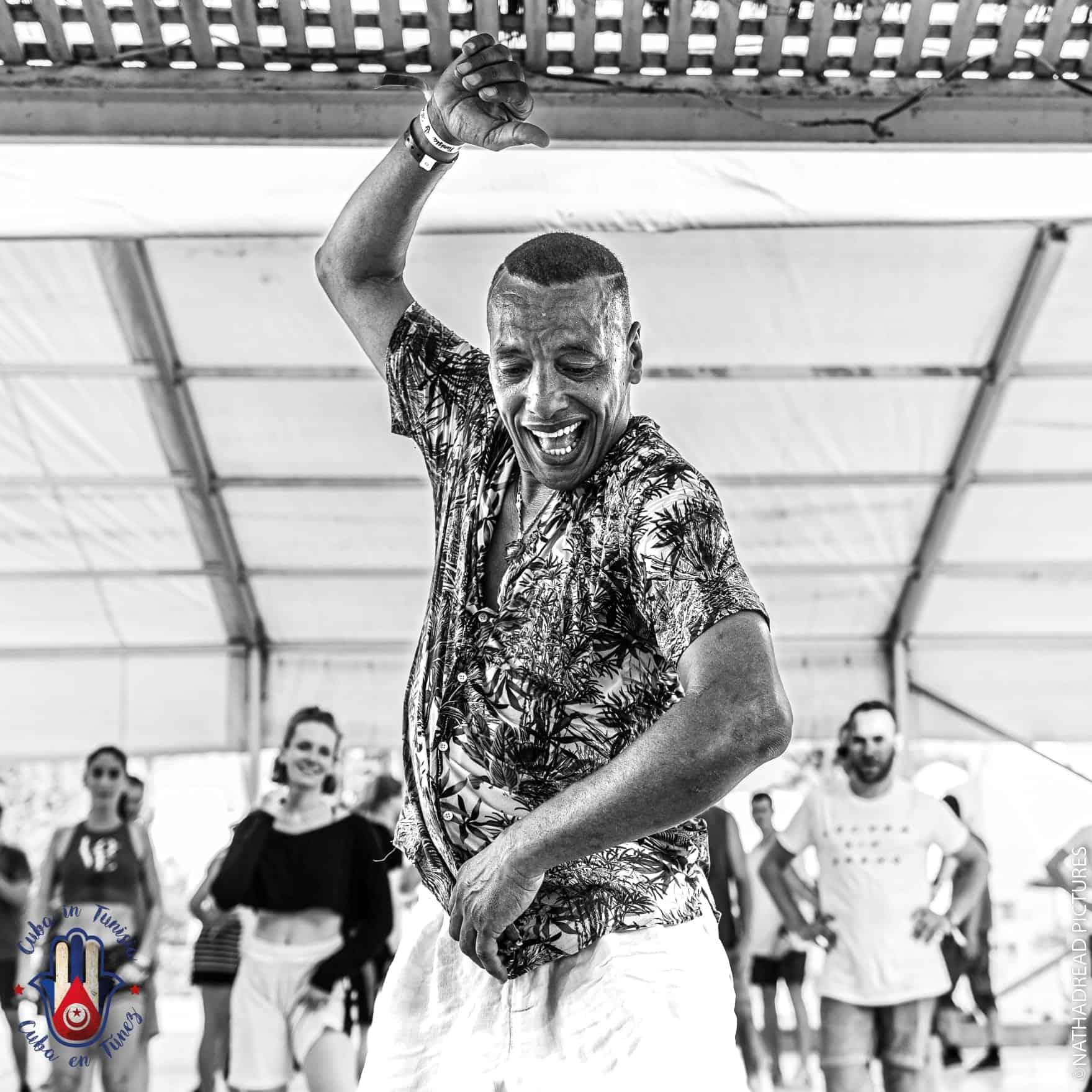
ALBERTO VALDÉS at a glance
- Stage name : Alberto Valdés (also spelled Valdes, Valdez or Valdès depending on the page)
- Origin : Cuba 🇨🇺 (Havana) [1][2]
- Born : around the mid-1960s, according to his accounts [2]
- Home base : Cyprus 🇨🇾 (his school is in Limassol)
- Activities : dancer, choreographer and teacher of Cuban dances
- Styles : Cuban Salsa, Rumba (guaguancó, columbia, yambú), Afro-Cuban dances, Rueda de casino
- Cuba, according to his biography : companies in Varadero, then the Tropicana de Cuba from 1990 to 1995
- Italy : Milan, from the 1990s onward
- Groups : Un Solo Pueblo, which became Otra Idea (late 1990s) · Clave Negra (Milan, 2002 according to his troupe, 2001 according to him)
- Schools : Cubabaila (near Milan, early 2000s) · BailenTodos DanzAcademy (Limassol)
- Stage partners : Albertico Calderón (Varadero, Tropicana, Un Solo Pueblo and Otra Idea) · Danis La Clave and the dancers of Clave Negra (Milan, from 2001-2002) · Andria Panagi, his wife, who has shared the bill with him since 2012 [2][3]
- Among his students : Fernando Sosa, who calls him his master
- Music : credited among the writers of the single Amor Divino (December 12, 2024)
- Status : active, on festival lineups in 2026
- Instagram : @albertovaldesofficial
Alberto Valdés: from Cuba to Cyprus, the Cuban Fernando Sosa calls his master
Alberto Valdés is a Cuban dancer, choreographer and teacher. According to his biography, he trains in Cuba, then moves to Milan, Italy, where he sets up performance groups, a Cuban dance school and a Rueda team. Today, he lives in Cyprus, where he teaches and performs with his wife, Andria Panagi.
Among his students: Fernando Sosa, who calls him his master.
About this article
This article follows Alberto Valdés’s life in order, from Old Havana to his stages in 2026, in his own words at every step, including his loves and his falling-outs. The facts come from his interviews, archives of his websites, the specialist press, festival programs and the pages of his students, colleagues and stage partners. The numbers in brackets refer to the notes at the bottom of the page.
Last updated: October 2026.
Contents
- Instructor of instructors, Tropicana, trophies? The 7 myths about Alberto Valdés
- Old Havana: a youth on the streets, failed attempts at sports, dancing for love
- Varadero, 1986-1987: the first job as a dancer
- Havana, 1990-1995: the Tropicana de Cuba, or the art of earning a place
- Genoa, 1991, then Milan: Italy, his “second homeland”
- Milan, late 1990s: Un Solo Pueblo, the Tropicana in Milan and Otra Idea
- 1997-2000: Fernando Sosa, the student who calls him his master
- Seveso, 2001: the Cubabaila school
- 2001-2002: Clave Negra, a troupe that became a family
- Ariccia, 2003: Rueda de casino and the world cup
- Rovinj, 2012: Andria Panagi, his partner on stage and in life
- Cyprus, 2016: BailenTodos DanzAcademy and the festivals
- 2019: an online dispute over Cuban casino
- 2024: Amor Divino, a single
- 2026: Nicosia, Limassol, Berlin, still on stage
- The titles he is given
- What he teaches: Cuban Salsa, Rumba and Afro-Cuban dances
- His values: sacrifice, respect, social dancing
- His life in dates
- In summary: a Cuban dancer and teacher
- Studio24’s artistic references
- Learning Salsa On1 in Liège and online
- FAQ: all about Alberto Valdés
- Sources and bibliography
“Alberto Valdés, mi primer maestro absoluto. Es un bailarín cubano.” (Alberto Valdés, my very first master. He is a Cuban dancer.) — Fernando Sosa, interview filmed at the Madrid Salsa Festival 2013, posted online on November 7, 2014 [4].
Fernando Sosa recounts his beginnings in more than ten videos, and the same name often comes up: his first teacher’s. People often know Alberto Valdés through his student.
But who is he? A boy from Old Havana who wanted to be a swimmer or a wrestler and became a dancer for love. A man who says he arrived at the Tropicana de Cuba “with no contract, no salary, nothing,” set up troupes in Milan, then started over in Cyprus with his wife. A master who has been given many titles, some of which he never asked for.
This article follows his journey in order, from Old Havana to Cyprus, through Varadero, the Tropicana, Milan and Rovinj. At every stage, his own words, and those of the woman he dances with today. But first, seven common beliefs to scrutinize.
Instructor of instructors, Tropicana, trophies? The 7 MYTHS about Alberto Valdés, TRUE or FALSE
Festival biographies, directories and blogs about Alberto Valdés circulate, copied from one page to another, attributing titles, feats and places to him. Seven common beliefs keep coming up. Which ones hold up? The verdict at a glance, then the details in the sections indicated. As for his age, the answer is in the FAQ.
❌ MYTH 1 · The instructor of instructors?
Alberto Valdés is said to be the instructor of instructors
✅ Festival wording — organizers are the ones who write this: it is an organizer’s phrase [3].
❌ MYTH 2 · The very first Cuban promoting Rueda in Europe?
He is said to be the very first Cuban to promote Rueda in Europe
✅ Exaggerated — a congress writes that he is “probably” the very first Cuban to promote Rueda in Europe [3], but his own biography only says that he is one of the first promoters of Rueda de casino in Italy [1].
❌ MYTH 3 · At the Tropicana de Cuba, really?
He is said to have danced at the Tropicana de Cuba from 1990 to 1995
✅ According to him, yes — he says he joined the Tropicana de Cuba in 1990 and stayed until 1995; no archive from the cabaret confirms this.
❌ MYTH 4 · Born at the Tropicana in Milan?
The Tropicana in Milan is said to have given rise to Alberto Valdés and the entertainers of his generation
✅ The same-name trap — the Tropicana de Cuba is a cabaret in Havana, while the one in Milan is a Latin nightclub, where he says he worked later.
❌ MYTH 5 · The creator of a style?
Alberto Valdés is said to have invented a method or a style
✅ Unproven as a style — the expression Valdes method appears in the sales description of his rumba DVDs. He says he created a method for teaching Rumba, not a style.
❌ MYTH 6 · A shower of trophies?
He is said to have won numerous awards
✅ Unproven — only one victory is dated: first place for his Rueda Cubabaila in Ariccia, near Rome, on December 14, 2003 [5][6]. He also says he trained competitors and had many champions: these are his students’ victories, not his own [2].
❌ MYTH 7 · The biggest school in Italy?
Cubabaila is said to be one of the biggest schools in Italy
✅ Festival phrasing — a 2012 biography says this without figures; the school’s text mentions three rooms and 500 m².
OLD HAVANA: a youth on the streets, failed attempts at sports, and dancing that came through love
Alberto Valdés is Cuban. On Instagram, he presents himself as a professional dancer and choreographer, from Cuba and based in Cyprus. And he describes himself this way: “Yo Soy así!!! Normal, Natural, Rumbero, salsero y Popular!!!” (That’s how I am! Normal, natural, rumbero, salsero and popular!) — Alberto Valdés, introduction on his Instagram account [7].
His name is spelled in different ways depending on the page: Valdés, Valdes, Valdez or Valdès. His Instagram account displays Alberto Valdes, without an accent. This article uses Alberto Valdés.
He comes from Cuba. He himself says he was born and grew up in Old Havana: “yo soy nacido y crecido en La Habana Vieja, que es un barrio calentito” (I was born and grew up in Old Havana, which is a rough neighborhood) — Alberto Valdés, interview by Franco Rocha, May 2020 [2]. His biography also says he was born in Havana [1]. His Instagram account only states that he is from Cuba [7].
No official document confirms his date of birth. His accounts, his biography and a point of reference given by Fernando Sosa place it around the mid-1960s [1][2][4]. This article gives neither a precise date nor an exact age.
He speaks of his youth with tenderness: “para mí fue una niñez bonita, una niñez de calle” (for me, it was a happy childhood, a childhood on the streets) — Alberto Valdés, interview by Franco Rocha, May 2020 [2]. On the streets, he says, you have to assert yourself and earn respect from a very early age.
Family plays a large part in it. He says he owes that to the upbringing he received from his father and his father’s family: “la familia era lo primero, los hermanos […] las mujeres, las madres, todo era importante en nuestra familia” (family came first, brothers […] women, mothers, everything was important in our family) — Alberto Valdés, interview by Franco Rocha, May 2020 [2]. He is the youngest of three brothers [2]. There was dancing at home too: “nonni che ballavano, quindi in casa sempre festa” (grandparents who danced, so there was always a party at home), he recounts in a 2013 interview [2].
As a young boy, he dreams of sports. Swimming first: he wins his competitions and is called up for the national swimming school, but on enrollment day, his name is not on any list. Then freestyle wrestling, where he says he never lost a competition; once again, no place at the national sports school. Then some track and field, where he has to stop in the middle of a race [2]. He draws his conclusion: “eso me conllevó a decir bueno, voy a bailar” (that led me to say to myself: well, I’m going to dance) — Alberto Valdés, interview by Franco Rocha, May 2020 [2]. He adds: “la cosa del baile sale con casualidad” (dancing happens by chance).
By chance, or rather for love. To the question “¿Cómo comenzó usted?” (How did you start?), he replies: “Enamorado. Por culpa de una chica, ok?” (In love. Because of a girl, okay?) — Alberto Valdés, Mambo Allegro, interview posted online on February 24, 2020 [2]. Then he explains: “empecé como artista aficionado en Cuba en las casas de cultura” (I started as an amateur artist in Cuba, in the cultural centers).
He tells the real story in detail. With a friend, deeply in love with a classmate who has gone to an arts education camp, he goes to join her. The instructor mistakes them for two selected students. He is immediately enthusiastic: “io subito ho preso l’entusiasmo […] rimango qua” (I got enthusiastic right away […] I’m staying here) — Alberto Valdés, Com’eravamo Salseri ’90, April 2020 [2]. His friend leaves; he stays for three years in a row. This camp trains arts education instructors: they learn Latin American and European dances, a little methodology and psychology, then pass it all on to the other students at school [2]. That, he says, is where he learned to teach.
Toward the end of middle school, he is already dancing in an amateur group that is very strong throughout the province, Tercer Mundo. He himself mentions the cultural centers and this amateur group; in interviews posted online in 2013 and then in 2026, he explains that his teacher at the time had the same last name as him, without being related [2]. He is admitted to the National School of Art Instructors, but his teacher asks him to choose between the school and the group. He sticks with dancing and also attends the national chemistry school, studying petrochemistry, to secure “una segunda carrera” (a second career) [2].
Wherever he goes, he forms his team: at chemistry school, he brings together two or three classmates and creates his group; in the army, he does it again with a dance group. “Nunca me paré” (I never stopped) — Alberto Valdés, interview by Franco Rocha, May 2020 [2].
VARADERO, 1986-1987: the first job as a dancer
Almost everything written about his youth comes from his troupe’s biography, which directories and festival programs copy in turn [1].
What does it say? Alberto Valdés starts very young in Cuba, in an amateur artists’ company, Tercer Mundo. His professional career begins in 1986, in a company in Varadero; he then moves on to a cabaret in the same city, then to the Tropicana de Cuba, from 1990 to 1995 [1]. He dates his professional debut to 1986 or 1987, in a folk dance group in Varadero [2]. He also says he studied at the Higher Institute of Art in Havana, without completing his studies [2].
He recounts how everything changed. At the time, he works as a technician at a large institution in Havana, where he is given tasks that are not his responsibility. One day, at the end of his rope, he leaves his post in the middle of a meeting and asks to leave his job. That day, walking down Obispo Street in Old Havana, he runs into a dancer he has not seen for two or three years. She tells him there is an audition that very day in Playa del Este for a folk dance group that is going to work in Varadero. He goes, sees several dancers from his amateur days again, and is accepted that same day [2].
For him, that impulsive decision changed everything: “si yo no rompía el muro ese, hoy no estuviera bailando” (if I hadn’t broken through that wall, I wouldn’t be dancing today) — Alberto Valdés, interview by Franco Rocha, May 2020 [2]. He told his partner at the time: “ya probé con el deporte y no dio […] a mí lo que me gusta es bailar, me voy a bailar” (I’ve already tried sports and it didn’t work out […] what I like is dancing, I’m going to dance). There was a period of separation in their relationship: “a un cierto punto nos separamos un poquito” (at one point, we separated for a little while), then “después nos reconciliamos, no pasó mucho tiempo, todo pasó rapidito” (then we got back together, it didn’t last long, everything happened quickly) [2].
Another Cuban dancer, Albertico Calderón, also mentions a cabaret in Varadero, the Cabaret Continental, in his own biography for the year 1988 [8]. Alberto Valdés himself says he danced there: during a tourism convention, he dances with the corps de ballet of the cabaret at the hotel Internacional, known to the public as the Cabaret Continental; the artistic director notices him and calls him back for each event. He describes this cabaret as Cuba’s second most important after the Tropicana, and he stays there for about a year and a half before joining the Tropicana [2].
That cabaret opens up another world to him, the world of variety shows, and brings him his first classical ballet lessons. “Because before that I only did Afro, popular Afro dances” (because, before that, I only did Afro, popular Afro dances) — Alberto Valdés, Com’eravamo Salseri ’90, April 2020 [2]. When he is offered a solo act for the summer show, he replies that two dancers would be better, and suggests Albertico Calderón, whom he knows from his amateur days: “si puedo contar con otro bailarín, que yo sé que vamos a bailar bien los dos, mejor la cosa” (if I can count on another dancer, someone I know I’ll dance well with, it will be better) [2]. The summer show, he says, is a great success with “the two of us” (the two of us).
HAVANA, 1990-1995: the TROPICANA DE CUBA, or the art of earning your place
Alberto Valdés says he joins the Tropicana de Cuba in 1990 and stays until 1995, in videos posted online in 2013, 2020, and 2026 [2]. His biography gives the same years [1]. No cabaret archive confirms these dates.
He arrives there, he says, for the cabaret’s fiftieth anniversary show: his artistic director from Varadero is appointed to lead the Tropicana and brings Albertico Calderón and him over. Santiago Alfonso, the great choreographer, had already noticed them on tour in Spain [2]. The arrival is tough: “We arrived there with no contract, no salary, nothing” (we arrived there with no contract, no salary, nothing) — Alberto Valdés, Com’eravamo Salseri ’90, April 2020 [2]. According to his account, he is the only one of the two accepted at the first audition; Albertico Calderón is accepted at the second.
At first, he dances at the very top, on the walkways: “cuando llegué a Tropicana era el último en la cola” (when I arrived at the Tropicana, I was last in line) — Alberto Valdés, interview by Franco Rocha, May 2020 [2]. He is asked to dance “para la pasarela, para allá arriba, cuando nadie te ve” (for the walkway, up there, when no one can see you). The days are long: three hours of classes, two hours of rehearsal, then an hour and a half of class with Santiago Alfonso. And he still has to get home: “en bicicleta para arriba y para abajo, de la Habana vieja a Tropicana, Tropicana a Habana vieja” (by bicycle, back and forth, from Old Havana to the Tropicana and back), because, as he recalls, “en los años 90 había la crisis total” (in the 1990s, it was a total crisis) [2].
His secret comes down to a few words: “estaba arriba del espejo constantemente tratando de superarme […] ahí es donde uno se gana el lugar, y no paré […]” (I was constantly in front of the mirror trying to outdo myself […] that’s where you earn your place, and I didn’t stop […]) — Alberto Valdés, interview by Franco Rocha, May 2020 [2]. Little by little, they move him down toward the stage and the dance floor. He also performs solo acts there: “También hice algunos números solistas en Tropicana, como el opening, el cierre […] Babalú” (I also did a few solo acts at the Tropicana, such as the opening, the closing […] Babalú) — Alberto Valdés, Mambo Allegro, February 24, 2020 [2].
He names choreographer Santiago Alfonso as his master [2]. This is how he speaks of him: “like a father to me” (like a father) — Alberto Valdés, Com’eravamo Salseri ’90, April 2020 [2].
GENOA, 1991, then MILAN: Italy, his “second homeland”
Alberto Valdés lives in Milan in the 1990s. He says he first came to Italy in 1991, with the Tropicana de Cuba, to Genoa, for a program on the Italian television network RAI celebrating the 500th anniversary of the discovery of America [2]. His first teaching contracts, he says, date from around 1992, with an organization called Ritmo Latino in the Brescia area; he then travels back and forth to Cuba to keep his place at the Tropicana [2].
He dates a turning point to that time: “Aquí empieza mi mundo, la gente empieza a conocerme, a llamarme ya con mi nombre” (Here is where my world begins, people start to know me, to call me by my name) — Alberto Valdés, LatinoChannelTV, December 21, 2011 [2]. In Milan, he starts out entertaining the crowd at Sabor Latino, an exclusively Latin nightclub, and teaching a few classes [2].
The pages differ on when he settled there: the article does not establish a date. The reference points come from his colleagues and students. Albertico Calderón, another Cuban dancer, arrives in Milan in 1996 with Alberto Valdés’s help: his school’s page speaks of “his friend and brother Alberto Valdes” (his friend and brother Alberto Valdes) [8]. Alberto Valdés and Fernando Sosa meet sometime between 1993 and 1997; Fernando Sosa mentions 1996 or 1997 in an interview posted online in 2012 [4][6][9].
He describes Italy when he arrived as a country with no common rule: the dancers, mostly Latin Americans, each danced “en el tiempo loro” (To their own timing), “quien bailaba en el tres, quien bailaba en el cuatro, quien bailaba en el uno” (Some on three, others on four or on one), and there was no academy, he says [2].
Sosa also remembers a club in northern Milan, where Alberto Valdés hosts dance nights with Albertico Calderón and gives a first class for free [4]. Alberto Valdés also says he hosted dance nights and taught a few classes on weekends for almost three years at the same venue, where he met Sosa [2]. Neither gives a precise date. In 1997, according to Sosa, Alberto Valdés organizes a study trip to Cuba: two weeks, five hours of classes a day. Sosa goes with him [4].
For him, Italy has given him everything: “I learned to teach in Cuba with this artistic education camp, but Italy has given me so much” (I learned to teach in Cuba, with this artistic education camp, but Italy has given me a lot). He speaks of it as a country of his own: “Italy is my second homeland” (Italy is my second homeland), and adds: “I am an Italian citizen” (I am an Italian citizen) — Alberto Valdés, Com’eravamo Salseri ’90, April 2020 [2]. Every return is a homecoming: “every time I go back there it’s like coming home” (every time I go back there, it’s like coming home).
MILAN, late 1990s: Un Solo Pueblo, the Tropicana in Milan, and Otra Idea
In the late 1990s, a dance entertainment and performance group emerges in Milan: Un Solo Pueblo, which becomes Otra Idea. According to Alberto Valdés, Un Solo Pueblo is a mixed group with members from several countries, including two Cubans at the start, Albertico Calderón and him [2]. He sees it as “uno de los primeros grupos de animación en Italia que tuvo un buen boom a nivel nacional” (one of the first dance entertainment groups in Italy, which enjoyed considerable national success) — Alberto Valdés, Mambo Allegro, February 24, 2020 [2].
The name comes about for a Sabor Latino night in a former factory, nicknamed “la fabbrica della salsa.” The entertainers dress as workers: hard hats, gloves, coveralls, boots in different colors, yellow for him [2].
Don’t confuse two venues with the same name. The Tropicana de Cuba is the cabaret in Havana. The Tropicana in Milan is a Latin nightclub on viale Bligny. A Milanese blog writes that artists including Alberto Valdés were born at the Tropicana in Milan: that is an exaggeration, and it is not the place he means when he says he comes from the Tropicana [10]. But he did work there: he says his group opened the Tropicana in Milan, which he describes as the city’s first Saturday night nightclub, with a show at the end of each month, and that Otra Idea began there [2].
According to Alberto Valdés, Otra Idea is a group of Cubans in which Fernando Sosa is the only non-Cuban [2]. Sosa and Rafael González describe Otra Idea as an all-male group [6]. According to Sosa, Alberto Valdés settles in Milan to put this group together [4]. Rafael González, a Cuban dancer in the group, says that both he and Sosa had already come from Alberto [11].
Accounts differ on the group’s creation. A Milanese school, Phoenix Studio Dance, describes a collective creation, with Albertico Calderón, Alberto Valdés, Fernando Sosa, and Danis La Clave [9]. Since these versions do not agree, the article names neither a founder nor a precise year of creation.
Rafael González gives two details about Otra Idea. The name, he says, comes from the cover of an Isaac Delgado record. And the group’s first show, according to him, combined popular dances and Afro dances [11]. Sosa then joins the group: in 1998, according to his biography, Alberto Valdés calls him to join Otra Idea, where he meets Rafael González [9].
In May 2000 (May 1, according to Sosa), Sosa and Rafael González leave Otra Idea to found Tropical Gem [6]. Sosa writes that it is “with the blessing of Alberto Valdes, whom I consider my Master and who has always followed us” (with the blessing of Alberto Valdes, whom I consider my master and who has always followed us) — Fernando Sosa, signed text, Salsa.it, May 27, 2020 [6]. Alberto Valdés is therefore not the founder of Tropical Gem: the company belongs to Sosa and Rafael González. He tells the same story in his own way: he had already decided, he says, to leave Otra Idea, and told them: “leave, start your own group, do your own thing” (leave, start your own group, do your own thing) — Alberto Valdés, Com’eravamo Salseri ’90, April 2020 [2].
1997-2000: FERNANDO SOSA, the student who calls him his master
Fernando Sosa often speaks of his master. In more than ten videos posted online between 2009 and 2025, he presents Alberto Valdés as his master [4]. Sosa’s own journey is told in his own article on this blog.
In an interview posted online in 2017, he sums up his beginnings this way: “empecé con Alberto Valdés, mi primer maestro y me llevó a Cuba” (I started with Alberto Valdés, my first master, and he took me to Cuba) — Fernando Sosa, interview with Anny Atehortua, posted online on January 23, 2017 [4].
Sosa dates that trip to Cuba to 1997. He often returns to the same expression of gratitude. In a video posted online in 2014, a few days before the Milano International Festival, he speaks of his great master. In another, posted online in 2019, he recalls his first true master, whom he met in Italy. In a third, posted online in 2020, he thanks his great teacher for showing him the true path [4].
Sosa also remembers a lesson from him: you are a person first, then a dancer [4].
Fernando Sosa’s page on his academy’s website repeats the same account. It says that Sosa met his Master Alberto Valdes there, and that his path then changed completely [9].
Other dancers name him among their teachers. Moustax Ba, an instructor at the Sosa Academy, studied Salsa with him [9]. In Naples, Riccardo Sozzino and Miriana Diotallevi say that, starting in 2013, they followed a course of study with several dancers, including him [9]. The Italian group Full Project also calls him its master [6].
This bond between master and student is the best-known aspect of his entire career. It rests mainly on two voices, those of Sosa and Rafael González, who are themselves students. Alberto Valdés confirms it in his own way. In an interview posted online in December 2011, he says he has the honor of being able to say: “yo le enseñé algunas cosas” (I taught him a few things), and adds that he worked with Sosa in Otra Idea. In an interview from May 2020, he says of Sosa: “tengo un gran amor y respeto para él […]” (I have great love and great respect for him […]); he himself names Sosa and Rafael González among the great dancers around him [2].
Do you want to learn Salsa On1?
🎓 Xavier teaches Salsa On1 at Studio24 in Liège. Or online anywhere in the world through Studio Live.
SEVESO, 2001: the CUBABAILA school
In Milan, Alberto Valdés runs a Cuban dance school, Cubabaila. According to him, the name comes from a study trip to Cuba called Cuba Baila, which he organized every spring, “religiosamente come dico io” (religiously, as I say), for groups of several dozen people, with Cuban masters including Santiago Alfonso: people knew him, he says, by his name and through that trip, hence the school’s name [2]. The school project takes shape in May-June 2001, and the opening takes place on September 30, 2001, in Seveso. In September 2003, the school moves to Cesano Maderno, into three rooms and 500 m² [5].
A page from his school, archived on December 10, 2002, announces workshops in the snow, the Ajiaco Latino, with Alberto Valdés among the masters [5]. Enmanuel Figuera, for his part, settles in Cesano Maderno in 2005, takes classes with Alberto Valdés and the members of Clave Negra, then teaches at Cubabaila starting in 2006 [9].
A 2012 festival biography presents Cubabaila as one of Italy’s largest and best-known dance schools. No figures accompany that description. The school itself describes three rooms and 500 m². We stick to what the school writes about itself [3][5].
2001-2002: CLAVE NEGRA, a troupe that became a family
After Otra Idea, Alberto Valdés dances alone for a year or a year and a half, then suggests forming another group to his friend Danis La Clave. He says it plainly: “Daniele Clave e io siamo quelli che abbiamo creato praticamente il gruppo” (Daniele Clave and I are the ones who practically created the group) — Alberto Valdés, Com’eravamo Salseri ’90, April 2020 [2]. According to the troupe’s website, in 2002, in Milan, he creates a performance group with Danis La Clave: Clave Negra. According to the same site, its repertoire blends cha-cha-cha, son, Rumba, Salsa, Afro dance styles, hip-hop, funk, reggaeton, and modern dance; in 2012, it names Emir García, Eloy Leyva, Tomasito Santamaria, and Gabriel Delgado “El Chino” alongside him [5].
By March 2002 at the latest, a page from his school presents it as a group “di recente formazione” (Recently formed) [5]; another school page, archived on December 10, 2002, also mentions it [5]. In an interview posted online in 2020, he says it began in 2001, though he hesitates [2]; a biography of one of the troupe’s dancers, on a Milan school’s website, describes it as active as early as 2001 [9]. A February 2003 announcement presents the troupe as “di fama già nota” (Already well known) [6].
In an interview posted online in 2011, he says the group combines dance, singing, and percussion; he says he sought varied backgrounds: dancers from classical dance, the Afro-Cuban world, hip-hop, and Cuban casino. He adds that the group involved the audience, that the name came from Danis La Clave, with his approval, and that the group was under his direction [2]. In an interview posted online in 2014, Sosa says he continues to perform with his group [4]. In April 2018, he is announced as a special guest at an evening event in Genoa, with a Rumba workshop early in the evening [6].
For him, Clave Negra was much more than a group: “Clave Negra para mí era familia” (for me, Clave Negra was a family) — Alberto Valdés, interview by Franco Rocha, May 2020 [2]. In 2020, he says the troupe lasted fourteen or fifteen years and has not performed together for about six years. But professionals still ask his permission to dance his choreographies, and he says yes: “para mí es un orgullo saber que se ha quedado en la memoria de las personas” (for me, it is a source of pride to know that it has stayed in people’s memories) [2].
ARICCIA, 2003: RUEDA DE CASINO and the world cup
Rueda de casino holds a special place in his career. According to Cuban scholar Barbara Balbuena Gutiérrez, rueda de casino originated in Cuba around 1956, “exclusively in the Club Casino Deportivo, a white social club” (Exclusively at the Club Casino Deportivo, a white social club); it is an “anonymous expression of urban people” (An anonymous expression of city dwellers), with no known creator [12]. She explains that in Cuba people learn casino within the family, because “no dance academies teach ballroom dance, and hence casino, to the population” (No academy teaches ballroom dance, and therefore casino, to the population) [12]. This book does not name Alberto Valdés. His biography presents him as one of the first promoters of Cuban Salsa and Rueda de casino in Italy [1].
On December 14, 2003, in Ariccia, near Rome, his Rueda Cubabaila takes first place in a Rueda world cup, by a unanimous decision of the judges. This is the only dated victory [5][6]. He recounts it himself in an interview posted online in 2020: “abbiamo vinto il primo posto” (we won first place), all the judges awarded it to him, unanimously, “la prima volta che succedeva” (the first time that had happened) — Alberto Valdés, Com’eravamo Salseri ’90, April 2020 [2]. He hesitates over the city (Turin or Rome) and does not give the year.
The SalsaNor Rueda Congress also presents him as the creator of Rueda Llanta, which he is said to have created in 2000 and taught for the first time at the Aarhus congress in 2012 [3]. In February 2004, in Rimini, he is among the guest judges at the Italian professional championship for Caribbean dances [6].
ROVINJ, 2012: on the bill with ANDRIA PANAGI, his stage partner and wife
Starting in 2012, a name appears next to his on posters: Andria Panagi. Festival organizers announce them together from 2012 to 2026 [3]. Even before settling in Cyprus, he is invited to Croatia. The Croatian Summer Salsa Festival, in Rovinj, announces them together for six editions between 2012 and 2019: 2012, 2013, 2014, 2016, 2017, and 2019. The 2012 edition describes him as then based in Milan [3]. In 2015, according to the SalsaNor Rueda Congress, they both serve as judges at the Rueda championship held in Roskilde, Denmark [3].
For him, she is much more than a stage partner. He presents her plainly as his wife and work partner: “quando insegno la mia gestualità insieme a mia moglie” (when I teach my body movement with my wife); showing a photo, he simply says: “questa è mia moglie” (this is my wife) — Alberto Valdés, Com’eravamo Salseri ’90, April 2020 [2]. In Spanish, he speaks of “mi esposa” (my wife) [2].
Their story begins, he recounts, as a work matter: “nuestra relación empezó como una relación de trabajo normal […] un evento que ella organizaba y que nosotros estuvimos acá, y bueno, aquí empezó toda la historia” (our relationship began as a normal working relationship […] an event she was organizing and where we were, here, and this is where the whole story began) — Alberto Valdés, interview by Franco Rocha, May 23, 2020 [2]. This was in Cyprus. Before that, he says, in the Czech Republic she had been “una gran promotora de la música cubana, de la cultura cubana, de organizar fiestas” (a great promoter of Cuban music, Cuban culture, and organizing parties), and he himself took part in some of her events there [2].
Their union unsettled those around them, and he makes no secret of it. He speaks of his separation from the person he had previously lived with: “ya cuando decidimos de unirnos, eso creó traumas a muchas personas, porque bueno, vamos a decir que nos unimos después de mi separación […]” (when we decided to come together, it caused trauma for many people because, let’s say it, we came together after my separation […]) [2]. People close to him, whom he loved or still loves, refused to accept this relationship. Andria, he says, helped him through it: “ella me ha dado fuerza para entender todo esto, digo ella, mi esposa” (she gave me the strength to understand all this, I mean her, my wife); and what ultimately prevailed was “la cosa importante que se impone en todo esto, ¿qué cosa es? El amor” (the important thing that prevails in all this, what is it? Love) [2]. The couple values their peace: “hemos creado esta familia, no permitimos que nadie nos las venga a romper” (we have created this family, we do not allow anyone to come and break it apart); “no permitimos ningún tipo de penetración externa en nuestra relación” (we do not allow any outside intrusion into our relationship) [2].
Andria Panagi also spoke about this period, in a message played during the same interview. She says: “yo no me enamoré de la pista pero de la persona” (I did not fall in love with the dance floor, but with the person), and mentions criticism from those around them: “nuestra relación no fue nunca llena de flores y mariposas, porque tenemos mucha gente que era contra nosotros” (our relationship was never full of flowers and butterflies, because many people were against us) — Andria Panagi, message played in Franco Rocha’s interview, May 23, 2020 [2]. Of their work together, she says: “Hemos trabajado mucho para nuestro producto de trabajo, para ofrecer una buena calidad […] los resultados se ven en el trabajo y la satisfacción de la gente que han participado en nuestras clases” (we have worked hard on our product, to offer good quality […] the results can be seen in the work and in the satisfaction of the people who have taken our classes) [2].
Of her as an artist, he says: “Ella, Andrea, tiene una capacidad de hacer coreografías que nadie la calcula, nadie” (She, Andrea, has an ability to create choreographies that no one imagines, no one) — Alberto Valdés, interview by Franco Rocha, May 23, 2020 [2]. Together, they later create BailenTodos DanzAcademy in Limassol.
CYPRUS, 2016: BailenTodos DanzAcademy and festivals
Today, Alberto Valdés describes himself as based in Cyprus, in interviews posted online in 2020 and then in 2026 [2], and his school is in Limassol. He appears on the bill as early as August 2016: the 7th CubaMiSalsa Festival, in Limassol, lists Alberto Valdes and Andria Panagi as headlining artists. In February 2017, from the 10th to the 12th, the 3rd BailenTodos Festival also announces them; its partner school is named CubaBaila Dance Academy, the same name as his school in Lombardy [3]. The exact year of his move varies from page to page: this article sticks to those posters. In 2020, he puts it this way: “adesso abito a Cipro che qua sto benissimo” (now I live in Cyprus, and I feel very good here) — Alberto Valdés, Com’eravamo Salseri ’90, April 2020 [2]. He has found a family there: “la famiglia di mia moglie che è come la mia perché mi adorano come io adoro loro” (my wife’s family, which is like my own, because they adore me just as I adore them).
There he co-directs BailenTodos DanzAcademy, in Limassol, with Andria Panagi: a Latin dance academy created by Alberto Valdés and Andria Panagi, two instructors with international experience. Classes cover Cuban Salsa, Bachata, Rueda, Rumba, son, timba, Afro dance styles, and reggaeton [3].
Organizers then book him regularly. He headlines the CubaMiSalsa Festival in Limassol in 2016, 2017, 2018, and 2019 (7th through 10th editions). In an interview posted online in February 2020, he announces that his group will parade the following week at the carnival in Cyprus to represent Cuba [2]. He appears at the LimasSol Salsa Festival in Agros, from July 31 to August 7, 2023, then at Latin World Stars in Cyprus, from December 5 to 8, 2025, which BailenTodos supports [3].
2019: an online DISPUTE over Cuban casino
In 2019, a very heated discussion about Cuban casino stirs social media. In an April 2020 interview, Alberto Valdés explains why he stepped in, although he says he usually stays out of these debates [2].
His rule is simple: give his opinion to anyone who asks him in person, but not on the internet. “Creiamo discordia, creiamo infelicità, creiamo insegurità, mille situazioni che in definitiva non hanno niente positivo” (We create discord, unhappiness, insecurity, a thousand situations that ultimately have nothing positive about them) — Alberto Valdés, Com’eravamo Salseri ’90, April 2020 [2].
This time, though, he made an exception. More and more people wrote to him personally: “per favore maestro intervenga” (please, master, step in). “Allora sono entrato io” (then I stepped in), he says: “io sono entrato a fare il mio commento, il mio video” (I came in to make my comment, my video) [2].
2024: AMOR DIVINO, a single
Back in 2010, Alberto Valdés had already written the lyrics to “Cubame,” with music by Miguel Enriquez [6]. He is also credited on a single, Amor Divino, with Massimo Scalici and la Poderosa Latin Orchestra, released on December 12, 2024. Massimo Scalici and he are among its writers [6].
Salsa.it presents the music video in an article dated June 12, 2025: Alberto Valdés is the lyricist and the protagonist of the dance scenes [6]. According to the specialist press, the project began in 2021 under the title “Tres Razones,” and the music video was filmed partly at Carini Castle [6].
2026: NICOSIA, LIMASSOL, BERLIN, still on stage
In 2026, three different organizers announce his appearance: United by Salsa, in Nicosia, on June 20; Guaba Goes Latin, in Limassol, on August 21 and 22; Afro Cuban Berlin, from October 9 to 11, a new small festival from the Berlin Salsa Festival team [3].
What touches him most is loyalty: “quando vado a qualche evento in Italia vedo gli allievi, sai, quelli vecchi di anni, che mi seguono ancora […] e quindi questo per me è una gran soddisfazione” (when I go to an event in Italy, I see the students, those from years ago, who still follow me […] and so, for me, that is a great satisfaction) — Alberto Valdés, Com’eravamo Salseri ’90, April 2020 [2].
The TITLES he is given: “instructor of instructors,” “master of masters”
Organizers sometimes add titles. In Croatia, in 2012, they announce him as “The Instructor of the Instructors” (the instructor of instructors) [3]. This is an organizer’s wording, which the article quotes without adopting it as its own. Even in the interviews posted online in 2020, “maestro de maestros” (Master of masters) is a term used by the hosts, and one of them says he took the liberty of writing, in his introductory biography, that he is an “embajador de la cultura cubana en el mundo” (Ambassador of Cuban culture in the world) [2].
He responds simply: “gracias por llamarme embajador” (thank you for calling me an ambassador) — Alberto Valdés, interview by Franco Rocha, May 2020 [2].
What he TEACHES: Cuban Salsa, Rumba, and Afro-Cuban dances
Schools, stores, and festivals describe the same repertoire: Cuban Salsa, Rumba (guaguancó, columbia, yambú), Afro-Cuban dances, and Rueda de casino. His school in Limassol adds son, timba, and other dances [3][13].
An online store sells several of his DVDs: Bases de Rumba Cubana, Pasitos Cubanos, Rumba Columbia for Men, followed by two volumes of Salsa Cubana, at intermediate and intermediate-advanced levels. The Rumba DVD is in Spanish [13].
Two festival programs confirm this repertoire in his advertised classes: in 2009, Rumba columbia and Yoruba folklore; in 2024, in Meyzieu, yambú, guaguancó, and Salsa with Afro elements [3].
In a video posted online in March 2019, he says not to overuse rumba elements when dancing Salsa: “estamos bailando salsa, no estamos bailando rumba” (We are dancing salsa, not rumba). These elements, he says, serve only as decoration: “un 8, dos 8, un adorno, una decoración y andando” (One eight, two eights, an embellishment, a decoration, and we keep going) [2].
This repertoire is passed on. Sosa says he started with Rumba and Afro thanks to his teacher [4]. Rafael González says he learned Afro, Rumba, and the teaching method from Alberto Valdés and Albertico Calderón [11]. What people recognize in him comes from his teacher: “è qualcosa che ho preso io del mio maestro Santi Alfonso, l’ho fatta molto mia” (it is something I took from my teacher Santi Alfonso, I made it very much my own) — Alberto Valdés, Com’eravamo Salseri ’90, April 2020 [2].
Should we speak of a Valdés method? The word method appears in the product descriptions of his rumba DVDs, which number the basics (Base 1 through Base 4 or 5, depending on the listings) [13]. In an interview posted online in 2020, Alberto Valdés also says he created a way to teach Rumba to Italian students, using numbered basics, following a comment from an Italian attending his class; in another, posted online in 2011, he describes himself as one of the pioneers of the method and of teaching salsa in Italy and Europe [2]. He does not speak of inventing a style: he says the movement associated with him comes from his teacher Santiago Alfonso [2]. This is therefore a repertoire that is taught and a teaching method, rather than an invention.
His VALUES: sacrifice, respect, and social dancing
Sacrifice first: for him, nothing is achieved without effort. “Los golpes en la vida te enseñan, las caídas en la vida te enseñan a levantarte, a seguir para adelante” (life’s blows teach you, life’s falls teach you to get back up, to keep going) — Alberto Valdés, interview by Franco Rocha, May 2020 [2]. Then respect: “los nuevos talentos tienen que respetar, reconocer a todos aquellos que crearon la base, a todos aquellos que le transmitieron algo, ser agradecidos” (new talents must respect and acknowledge all those who created the foundation, all those who passed something on to them, and be grateful) [2].
He has worked on his temperament. “Yo de joven tenía muy mal carácter” (When I was young, I had a very bad temper), he says, adding: “el arte me enseñó a hablar, a ser diplomático, a conversar” (art taught me to speak, to be diplomatic, to converse) — Alberto Valdés, interview by Franco Rocha, May 2020 [2]. When a friendship breaks down, he says it plainly: “no sé odiar pero sé olvidar” (I do not know how to hate, but I know how to forget), and “no te estoy odiando. Simplemente te alejo de mi vida” (I do not hate you, I simply remove you from my life) [2].
In a video message posted online in May 2020, he asks dancers not to confuse partying with competition: “bailemos social. No estamos en una competencia” (Let’s dance socially. We are not in a competition), and “no es necesario demostrar que tú eres el rey del mundo” (there is no need to prove that you are the king of the world) — Alberto Valdés, video message, May 18, 2020 [2].
Family matters as much as the stage. His eldest son, William Valdés, also dances and teaches: “lo tuve bajo mi ala, bajo mi enseñanza por un buen tiempo […] se ha transmitido, vamos a decir, casi la misma energía y simpatía al enseñar” (I had him under my wing, under my teaching, for quite a while […] we passed on to him, let’s say, almost the same energy and the same warmth in teaching) — Alberto Valdés, interview by Franco Rocha, May 2020 [2]. And for him, family also means dance: “la familia es todo, y cuando eso te falta, te falta gran parte de tu vida” (family is everything, and when you are missing that, you are missing a large part of your life) — Alberto Valdés, interview by Franco Rocha, May 2020 [2].
He places all of this within a mission: “esto mío es una misión en mi vida, que me gusta mucho […] una misión que me ha dado Dios, Changó y todos los santos” (this is a mission in my life, which I love very much […] a mission given to me by God, Changó, and all the saints) — Alberto Valdés, interview by Franco Rocha, May 2020 [2].
His life in DATES
To help you find your bearings, here are the key dates, along with who provides them.
- 1986 to 1995, according to his biography and his own account — Professional debut in Varadero in 1986 or 1987, then the Tropicana de Cuba from 1990 to 1995 [1][2].
- 1990s — He lives in Milan. First visit to Italy in 1991 and first contracts around 1992, according to his account; the date he settled there varies from page to page [2][4][8].
- 1997, according to Sosa — Study trip to Cuba organized by Alberto Valdés [4].
- Late 1990s — Un Solo Pueblo, which became Otra Idea [4][9][11].
- May 2000 — Sosa and Rafael González leave Otra Idea and found Tropical Gem [6].
- 2001 — Opening of Cubabaila in Seveso, on September 30 [5].
- 2001 or 2002 — Creation of Clave Negra in Milan: 2002 according to the troupe’s text, 2001 according to him; a page from his school describes it as “recently formed” in March 2002 [2][5].
- December 14, 2003 — First place for his Rueda Cubabaila at a Rueda world cup in Ariccia, near Rome [5][6].
- 2012 to 2019 — Six editions of the festival in Rovinj, Croatia, on the lineup with Andria Panagi [3].
- 2015, according to the SalsaNor Rueda Congress — Judge at the Rueda championship in Roskilde [3].
- August 2016 — First known appearance on a lineup in Cyprus: the 7th CubaMiSalsa Festival, in Limassol; then, from February 10 to 12, 2017, the 3rd BailenTodos Festival [3].
- December 12, 2024 — Release of the single Amor Divino [6].
- 2026 — On the lineup in Nicosia, Limassol, and Berlin [3].
IN SUMMARY: a Cuban dancer and teacher
To finish, here are the essentials.
- In his own words — He presents himself as a Cuban dancer and choreographer based in Cyprus [7]. He says he comes from the Tropicana de Cuba, cites Santiago Alfonso as his teacher, and introduces Andria Panagi as his wife and work partner [2].
- In his students’ words — Fernando Sosa and Rafael González discuss his role in their careers: Rumba, Afro-Cuban dances, Otra Idea; Sosa also recounts a study trip to Cuba with him [4][11].
- On posters and in archives — He appears on festival lineups from 2012 to 2026, co-directs an academy in Limassol, and his school Cubabaila existed near Milan [3][5].
- In his biography — The details of his career in Cuba before the Tropicana [1]. He himself confirms his birth in Havana, his beginnings in Varadero, and his years at the Tropicana [2].
That is why this article discusses a Cuban dancer and teacher, rather than an inventor or an official title.
Studio24’s artistic REFERENCES
Alberto Valdés’s career crosses paths with those of two artists featured on this blog. Fernando Sosa first: he calls Alberto Valdés his first teacher and says he took him to Cuba in 1997 [4]. Adolfo Indacochea next: both appear on the lineup of the Croatian Summer Salsa Festival in Rovinj, notably in 2014 and 2019 [3], and in an interview with Adolfo posted online in 2020 on the Sabor Latino OnLine TV channel, Alberto Valdés is named among the dancers in Italy, alongside Fernando Sosa [8]. These profiles complement this one.
All the blog’s profiles are collected on the page devoted to the great names in Salsa, Mambo, and Bachata.
Learning SALSA ON1 in Liège and online
Xavier Colina saw Alberto Valdés at the Warsaw Salsa Festival. He also studies his training course in the World Mastery program.
At Studio24, the Tuesday Salsa On1 class is called Sosa Style, after Fernando Sosa, who calls Alberto Valdés his teacher.
In Liège, Salsa On1 is danced on Tuesdays : Introductory at 6:30 pm, Basics+ at 7:30 pm, Intermediate at 8:30 pm. After about a year of practice, it is time for the Advanced level on Thursdays at 7:30 pm. Everywhere else, Studio Live offers its video classes for you to follow at your own pace.
Want to dance Salsa On1?
🎓 Xavier teaches Salsa On1 at Studio24 in Liège. Or online anywhere in the world through Studio Live.
FAQ: all about ALBERTO VALDÉS
🌎 Who is ALBERTO VALDÉS?
Alberto Valdés is a Cuban dancer, choreographer, and teacher of Cuban Salsa, Rumba, and Afro-Cuban dances. Born in Havana, he trains in Cuba. He lives in Milan from the 1990s, where he runs the Cubabaila school and, according to his troupe, creates the group Clave Negra. He later appears on lineups in Cyprus, by 2016 at the latest. Fernando Sosa introduces him as his first teacher.
💘 How did he start DANCING?
For love, he says: “Enamorado. Por culpa de una chica” (In love. Because of a girl). He follows a classmate to an arts education camp, stays there for three years, and learns to teach [2].
🎂 How OLD is Alberto Valdés?
No official document confirms his date of birth. According to his accounts, he appears to have been born around the mid-1960s; his biography and a reference point given by Fernando Sosa point in the same direction. This article publishes neither a date of birth nor an exact age.
🇨🇺 Where is Alberto Valdés from?
From Cuba. He says himself that he was born and grew up in Old Havana, and his biography also says he was born in Havana; his Instagram account only states that he is from Cuba. He now presents himself as based in Cyprus.
🎭 Did he dance at the TROPICANA?
He says himself that he comes from the Tropicana de Cuba, which he joins in 1990 and stays at until 1995 [2] ; his biography gives the same years. No archive from the cabaret confirms this. Do not confuse it with the Tropicana in Milan, a Latin nightclub where he also worked later.
🎓 Is Alberto Valdés FERNANDO SOSA’s teacher?
Fernando Sosa introduces him as his teacher in more than ten videos, and his academy’s page calls Alberto Valdes his Master. Rafael González, co-founder of Tropical Gem, says that both he and Sosa came from Alberto Valdés. These are students’ accounts. Also read the biography of Fernando Sosa.
👥 What is OTRA IDEA?
It is a performance group of Cuban dancers, all male according to Fernando Sosa and Rafael González, in Milan in the late 1990s. It grew out of Un Solo Pueblo, a mixed-gender entertainment group according to Alberto Valdés, who adds that Sosa was its only non-Cuban member. Fernando Sosa and Rafael González were members before founding Tropical Gem in May 2000. The accounts agree on neither the founder nor the year it was created.
🪙 Did Alberto Valdés found TROPICAL GEM?
No. Tropical Gem is Fernando Sosa and Rafael González’s company, founded in May 2000 after they left Otra Idea. Sosa writes that they founded it with the blessing of Alberto Valdés, whom he considers his mentor.
👫 Who is ANDRIA PANAGI?
Andria Panagi is Alberto Valdés’s wife and his teaching and stage partner. Festival organizers list them together from 2012 to 2026, and she co-directs BailenTodos DanzAcademy with him in Limassol. He says it himself: “questa è mia moglie” (this is my wife) [2].
💃 Who does he dance with on STAGE?
Today, with Andria Panagi, who has been billed alongside him since 2012. Previously, in Cuba and then in Milan, he shared the stage with his friend Albertico Calderón, at the Varadero cabaret, at the Tropicana de Cuba, then in Un Solo Pueblo and Otra Idea, and with the dancers of Clave Negra: Danis La Clave, Eloy Leyva, Tomasito Santamaria, Emir García and Gabriel Delgado “El Chino.”
🏫 What are CUBABAILA and CLAVE NEGRA?
Cubabaila is his Cuban dance school near Milan: it opened on September 30, 2001, in Seveso, then moved to Cesano Maderno in September 2003 [5]. Clave Negra is a performance group created in Milan in 2002 with Danis La Clave, according to the troupe’s website; he says 2001; a page on his school’s website describes it as “recently formed” as early as March 2002 [2][5].
🏆 Is Alberto Valdés the instructor of instructors?
It is a label used by festival organizers, for example in Croatia in 2012. These are organizers’ words.
🌍 Where does he teach today?
In Limassol, Cyprus, at BailenTodos DanzAcademy, which he co-directs with Andria Panagi. He is also on festival lineups in 2026: United by Salsa in Nicosia, Guaba Goes Latin in Limassol and Afro Cuban Berlin.
🎪 Which FESTIVALS invite him?
Organizers list him in Croatia, in Rovinj, from 2012 to 2019, and in Cyprus from 2016 to 2026. He is also a guest judge in Rimini, Italy, in 2004, then a judge in Roskilde, Denmark, in 2015 (according to the SalsaNor Rueda Congress), and a special guest at a party in Genoa in 2018. Two programs mention his name in 2009 and in 2024, in Norway and in Meyzieu.
💃 What STYLES does he teach?
Cuban Salsa, Rumba (guaguancó, columbia, yambú), Afro-Cuban dances and Rueda de casino. His school in Limassol also offers Bachata, son, timba and reggaeton.
🎵 What is AMOR DIVINO?
A single released on December 12, 2024, with Massimo Scalici and the Poderosa Latin Orchestra. Alberto Valdés is credited among its writers. He wrote the lyrics and is the main performer in the music video’s dance scenes, which Salsa.it presents in an article dated June 12, 2025.
🧭 What do we know about his youth in Cuba?
Almost everything comes from his troupe’s biography, copied from page to page [1], and from his own interviews [2]: he says he was born in Havana, grew up in Old Havana, made his debut in Varadero, then joined the Tropicana de Cuba in 1990. No cabaret archive confirms this.
📱 Where can you FOLLOW Alberto Valdés?
On Instagram: @albertovaldesofficial [7].
🎓 Want to dance SALSA ON1? Where should you start?
With the foundations — that’s where it all happens. Xavier Colina teaches Salsa On1 at Studio24 Liège. In Liège: first trial class for 10€, no reservation needed. Just starting out? Come on Tuesday at 6:30 pm for Introduction. Then, Basics+ at 7:30 pm and Intermediate at 8:30 pm. On Thursday, the Advanced level includes Salsa On1 at 7:30 pm. Practice in the evenings at Puerto Rico Nights. Anywhere in the world: Studio Live — +300 HD lessons, 7-day free trial.

About the author
Xavier Colina teaches Salsa On1, Mambo On2 and Bachata at Studio24 in Liège (Belgium) and online through Studio Live. Trained in the direct lineage of Eddie Torres → Adolfo Indacochea (World Mastery program), Fernando Sosa and Korke y Judith. Learn more →
Sources & Bibliography
- ↩
His biography, reproduced from page to page :
GO&DANCE. Alberto Valdes [online]. Artist profile. Available at: https://www.goandance.com/en/artist/4604/alberto-valdes [accessed October 21, 2026].
CLAVE NEGRA. ClaveNegra – 100% cubano [online]. Alberto Valdes’s profile on his troupe’s website. Available at: http://web.archive.org/web/20070701102506/http://www.clavenegra.it:80/curry_valdes.aspx [archived July 1, 2007, accessed October 21, 2026].
Clarifications: This biography is copied on numerous pages (directories, festival programs). These pages repeat his own account. - ↩
Alberto Valdés speaks — interviews and videos (2011-2026) :
LATINOCHANNELTV, 2011. Clave Negra – Entrevista con Alberto, Emir y Eloy [online]. LatinoChannelTV, December 21, 2011. Available at: https://youtu.be/bkxRzlnDqbU [accessed October 21, 2026]. Passages cited: starting at 08:29 ; 14:09.
KARMATTV PRODUZIONE, 2013. Alberto Valdès – Intervista Karmat Produzione [online]. Karmattv produzione, December 17, 2013. Available at: https://youtu.be/_sDJcyX7aWA [accessed October 21, 2026]. Passages cited: starting at 01:15 ; 04:41.
TVSABORLATINO, 2019. ✅ Alberto Valdes habla como se baila en la pista de baile ✅ [online]. TVSaborLatino, March 3, 2019. Available at: https://youtu.be/zUFPBMkiurY [accessed October 21, 2026]. Passages cited: starting at 00:41 ; 01:27.
MAMBO ALLEGRO, 2020. Alberto Valdes Interview [online]. Mambo Allegro, February 24, 2020. Available at: https://youtu.be/00aUJcTufXs [accessed October 21, 2026]. Passages cited: starting at 00:25 ; 00:27 ; 00:32 ; 01:29 ; 02:02.
COM’ERAVAMO SALSERI ’90 STORIA DI UN’EPOCA, 2020. COM’ERAVAMO…SALSERI ’90 – LA GRANDEZZA DELL’UMILTA’ Intervista ad ALBERTO VALDES [online]. Com’eravamo Salseri ’90 Storia di un’epoca, April 15, 2020. Available at: https://youtu.be/5Uzp1VSpajg [accessed October 21, 2026]. Passages cited: starting at 16:50 ; 23:43 ; 29:12 ; 31:34 ; 1:25:08 ; 1:37:42 ; 1:39:43 ; 2:04:22 ; 2:07:54 ; 2:08:30 ; 2:13:48 ; 2:23:23 ; 2:25:42 ; 2:25:52 ; 2:28:25 ; 2:31:26 ; 2:37:50 ; 2:55:10 ; 2:55:18 ; 2:55:54 ; 2:55:59 ; 2:56:15 ; 2:57:56.
FRANCO ROCHA, 2020. Reflexión del Maestro Alberto Valdes De ” TU A TU ” con Franco Rocha [online]. Franco Rocha, May 18, 2020. Available at: https://youtu.be/zOeyDZYPCnI [accessed October 21, 2026]. Passages cited: starting at 00:32 ; 03:05.
FRANCO ROCHA, 2020. DE ” TU A TU ” FRANCO ROCHA CON ALBERTO VALDES [online]. Franco Rocha, May 23, 2020. Available at: https://youtu.be/OCvugXLz1W4 [accessed October 21, 2026]. Passages cited: starting at 01:43 ; 01:48 ; 05:17 ; 05:32 ; 10:28 ; 10:34 ; 12:27 ; 15:34 ; 20:22 ; 20:30 ; 20:37 ; 20:49 ; 20:53 ; 22:48.
FRANCO ROCHA, 2020. De ” Tu a Tu ” Franco Rocha con Alberto Valdes [online]. Franco Rocha, May 23, 2020. Available at: https://youtu.be/vOsTIzNBmGA [accessed October 21, 2026]. Passages cited: starting at 03:49 ; 04:38 ; 04:50 ; 04:54 ; 05:12 ; 05:15 ; 06:02 ; 07:50 ; 14:16 ; 15:06 ; 19:07 ; 19:16 ; 19:55 ; 20:05 ; 22:33 ; 23:18 ; 23:34 ; 23:57 ; 25:31 ; 25:51 ; 26:16 ; 26:33 ; 26:54. Clarification: second part of Franco Rocha’s interview.
FRANCO ROCHA, 2020. De ” Tu a Tu ” Franco Rocha con Alberto Valdes [online]. Franco Rocha, May 23, 2020. Available at: https://youtu.be/kUxFQMCOsB8 [accessed October 21, 2026]. Passages cited: starting at 01:06 ; 01:55 ; 02:16 ; 02:52 ; 08:43 ; 14:34 ; 20:58 ; 21:41 ; 22:38 ; 22:50 ; 22:54 ; 22:58. Clarification: third part of Franco Rocha’s interview.
SALSON RADIO OFICIAL, 2026. Sabado 02-05-26 Intrevista a Alberto Valdes – Dj Manuel Merlini – Salsonradio.net Milano – Italia [online]. Salson Radio Oficial, May 2, 2026. Available at: https://youtu.be/vy55oZ_Slzs [accessed October 21, 2026]. Passages cited: starting at 26:22 ; 26:27.
Clarifications: These interviews recount his own memories. The French translations of the quotations are by the author; speech hesitations (repeated words, « um », « uh ») have been removed, and any other omission is marked […]. In Franco Rocha’s interview of May 23, 2020, Andria Panagi’s message is broadcast live; he says “Andrea” or “Andrea Panayí” where the posters say Andria Panagi. The host also introduces her as « su pareja de baile y esposa » and adds that « detrás de un gran maestro […] también tiene que haber una gran mujer que proteja, que lo proteja »: these are his words, not Alberto Valdés’s. Regarding the Tropicana, he says in the April 2020 interview that he had not taken the soloist qualification test: he was a « corifeo », the soloist’s substitute, and danced solo numbers. Regarding the 2019 dispute, it is the interview host who places it in the context of Cuban casino; the remarks about the person being called into question are not reproduced. Dates: the period at the Tropicana from 1990 to 1995 is mentioned in three interviews; the date of his arrival in Cyprus varies from page to page, and the text relies on the posters from 2016 and 2017. - ↩
Festival and event organizers (appearances in the lineup) :
SALSA ADRIA PRODUKCIJE. 8th Croatian Summer Salsa Festival, Rovinj 2012 [online]. Artists page: Alberto & Andria. The 2012 edition describes him as living in Milan and owning Cubabaila. Available at: https://www.crosalsafestival.com/2012/layout/set/print/artists/alberto_andria [accessed October 21, 2026].
SALSA ADRIA PRODUKCIJE. 9th Croatian Summer Salsa Festival, Rovinj 2013 [online]. Artists page: Alberto Valdes & Andria Panagi; festival from June 24 to July 1, 2013. Available at: https://www.crosalsafestival.com/2013/artists/artists/alberto_valdes_andria_panagi [accessed October 21, 2026].
SALSA ADRIA PRODUKCIJE. 10th Croatian Summer Salsa Festival, Rovinj 2014 [online]. Artists page; festival from June 23 to 30, 2014. Available at: https://www.crosalsafestival.com/2014/artists [accessed October 21, 2026].
SALSA ADRIA PRODUKCIJE. 12th Croatian Summer Salsa Festival, Rovinj 2016 [online]. Artists page. Available at: https://www.crosalsafestival.com/2016/artists [accessed October 21, 2026].
SALSA ADRIA PRODUKCIJE. 13th Croatian Summer Salsa Festival, Rovinj 2017 [online]. Artists page. Available at: https://www.crosalsafestival.com/2017/artists [accessed October 21, 2026].
SALSA ADRIA PRODUKCIJE. 15th Croatian Summer Salsa Festival, Rovinj 2019 [online]. Artists page. Available at: https://www.crosalsafestival.com/2019/artists [accessed October 21, 2026].
CYPRUSEVENTS.NET. Cyprus : 7th CubaMiSalsa Cyprus Festival [online]. Limassol, August 1–8, 2016; list of confirmed artists: 1) Alberto Valdes, 2) Andria Panagi. Available at: https://www.cyprusevents.net/events/7th-cubamisalsa-cyprus-festival [accessed October 21, 2026].
GO&DANCE. 3rd BailenTodos Festival in Cyprus 2017 [online]. Limassol, February 10–12, 2017; partner school: CubaBaila Dance Academy (Limassol and Larnaca). Available at: https://www.goandance.com/en/event/2049/3rd-bailentodos-festival-in-cyprus-2017 [accessed October 21, 2026].
GO&DANCE. CubaMiSalsa Festival 2017 in Cyprus (8th Edition) [online]. Limassol, July 31–August 7, 2017. Available at: https://goandance.com/en/events/2061-8th-cubamisalsa-festival-in-limassol-cyprus [accessed October 21, 2026].
LATIN DANCE CALENDAR. 9th CubaMiSalsa Festival In Cyprus 2018 [online]. Cyprus, festival weekend from August 24 to 27, 2018. January 15, 2018. Available at: https://latindancecalendar.com/festivals/cubamisalsa-festival-cyprus/ [accessed October 21, 2026].
GO&DANCE. CubaMiSalsa Festival 2019 in Cyprus (10th Edition) [online]. Limassol, July 29–August 4, 2019. Available at: https://www.goandance.com/en/event/4397/cubamisalsa-festival-2019-in-cyprus-10th-edition [accessed October 21, 2026].
DANCEUS.ORG. Limassol Salsa Festival 2023 – Agros, Cyprus [online]. Agros, July 31–August 7, 2023. Available at: https://www.danceus.org/event/167452730132124/limassol-salsa-festival-agros-cyprus/ [accessed October 21, 2026].
TAP2DANCE. Latin World Stars in Cyprus 2025 – Winter Edition [online]. Festival in Agros; list of artists including Alberto Valdes and Andria Panagi; BailenTodos Academy is listed under “SUPPORTERS.” Available at: https://www.tap2-dance.com/events/97-latin-world-stars-in-cyprus-2025-winter-edition [accessed October 21, 2026].
EVENTOR. Latin World Stars: Winter Dance Festival 2025 in Agros [online]. Festival from December 5 to 8, 2025, in Agros; this announcement lists BailenTodos DanzAcademy among the organizers, while the Tap2Dance page lists it under “SUPPORTERS”: the text uses “supports.” Available at: https://eventor.com.cy/events/limassol/latin-world-stars-winter-dance-festival-2025-in-agros-10627 [accessed October 21, 2026].
UNITED BY SALSA. United by Salsa — 1st Edition [online]. Nicosia, June 20, 2026. Available at: https://unitedbysalsa.dloizides.com/ [accessed October 21, 2026].
TAP2DANCE. Guaba Goes Latin – August Edition [online]. Limassol, August 21 and 22, 2026. Available at: https://www.tap2-dance.com/events/885-guaba-goes-latin-august-edition [accessed October 21, 2026].
CUBANSALSA.NL. Afro Cuban Berlin | Fiesta Elegante [online]. Festival from October 9 to 11, 2026, “a new, small-scale festival from the team behind Berlin Salsa Festival”; artists: Alberto Valdes at the top of the list. Available at: https://www.cubansalsa.nl/en/festivals/berlin-salsa-festival-fiesta-elegante-2026 [accessed October 21, 2026].
BERLIN SALSA FESTIVAL. Artists October 2026 [online]. Organizer’s page, October 2026 lineup. Available at: https://www.berlinsalsafestival.com/artists-october-2026 [accessed October 21, 2026].
BERLIN SALSA FESTIVAL. Alberto Valdes [online]. Organizer’s page, October 2026 lineup. Available at: https://www.berlinsalsafestival.com/artists-october-2026/alberto-valdes [accessed October 21, 2026].
SALSANOR RUEDA CONGRESS. Alberto Valdes & Andria Panagi [online]. Page from 2024: judge at the first Rueda de casino world championship, Roskilde (2015); “probably the very first Cuban dancer to be promoting rueda de casino in Europe.” January 23, 2024. Available at: https://www.ruedacongress.com/artist/alberto-valdes-andria-panagi/ [accessed October 21, 2026].
RUEDA.CASINO. Rueda llanta [online]. SalsaNor page, updated January 6, 2025: “Rueda llanta was created by Alberto Valdes (Cuba/Cyprus) in the year 2000”; first taught at the Aarhus congress in 2012. July 31, 2018. Available at: https://rueda.casino/rueda-structures/rueda-llanta/ [accessed October 21, 2026].
GO&DANCE. BailenTodos DanzAcademy [online]. Latin dance academy founded by Alberto Valdés and Andria Panagi. Available at: https://www.goandance.com/en/school/2657/bailentodos-danzacademy [accessed October 21, 2026].
HOT SALSA. 5th International Cuban Salsa Festival Norway [online]. PDF program, Oslo, October 22–25, 2009: Rumba columbia and Yoruba folklore with Alberto Valdes. Available at: https://admin.mekke.no/data/downloads/411/ProgramHotSalsa2009FestivalEdition.pdf [accessed October 21, 2026].
ALL SALSA FESTIVAL, 2024. Festival program, Meyzieu, 2024: yambú, guaguancó and Salsa with Afro elements. Reference without a link (program unavailable on October 21, 2026).
Clarifications: “in the lineup together” means appearing in the same lineup, rather than a duo established at a given date: the Rovinj 2012 and 2013 profiles present Andria Panagi separately and describe her as having been Brazilian Jorge Maryano’s dance partner since October 2009. The Rueda Congress profile describes her as “dance and life-partner”; the information about judging in Roskilde in 2015 and Rueda Llanta (2000, Aarhus 2012) comes solely from that congress. Rovinj: six editions, 2012, 2013, 2014, 2016, 2017 and 2019. CubaMiSalsa Festival, Limassol: 2016 (7th edition, August 1–8), 2017, 2018 and 2019. 2026: United by Salsa, Guaba Goes Latin and Afro Cuban Berlin (October 9–11, Berlin Salsa Festival team). - ↩
Fernando Sosa talks about Alberto Valdés — interviews and videos (2009–2025) :
TATIANA BONAGURO, 2009. FERNANDO SOSA TROPICAL GEM MESSAGGIO A TUTTI I SALSERI MENSAJE PARA TODO LOS SALSEROS [online]. Tatiana Bonaguro, February 25, 2009. Available at: https://youtu.be/Y63rrgmWa_U?t=154 [accessed October 21, 2026]. Cited passage: starting at 2:34.
SALSAONU BRASIL (SALSA ON YOU), 2012. Fernando Sosa – Entrevista [online]. SalsaOnU Brasil (salsa on you), May 24, 2012. Available at: https://youtu.be/bmdY-vF8KmE?t=72 [accessed October 21, 2026]. Cited passage: starting at 1:12. Clarification: meeting with Alberto Valdés: “más o menos en el 96, 97.”
SALSOLICOSANONIMOS, 2014. Fernando Sosa entrevista en Madrid Salsa Festival 2013 [online]. SalsolicosAnonimos, November 7, 2014. Available at: https://youtu.be/8PoXfFtCuPM?t=47 [accessed October 21, 2026]. Cited passage: starting at 0:47. Clarification: interview filmed at Madrid Salsa Festival 2013.
NOI CHE AMIAMO FERNANDO SOSA, 2014. INTERVISTA A FERNANDO SOSA A POCHI GIORNI DAL INIZIO DEL MILANO INTERNATIONAL FESTIVAL [online]. Noi che amiamo Fernando Sosa, November 10, 2014. Available at: https://youtu.be/tcZ2VeHHItA?t=94 [accessed October 21, 2026]. Cited passage: starting at 1:34.
ANNY ATEHORTUA, 2017. Tropical Gem – Entrevista a Fernando Sosa [online]. Anny Atehortua, January 23, 2017. Available at: https://youtu.be/TT4o3hjrVZ0?t=734 [accessed October 21, 2026]. Cited passage: starting at 12:14.
TVSABORLATINO, 2019. ENTREVISTA A FERNANDO SOSA – INICIOS – VIDA – OPINION [online]. TVSaborLatino, January 22, 2019. Available at: https://youtu.be/UgYtXNNZGpQ?t=69 [accessed October 21, 2026]. Cited passage: starting at 1:09.
COM’ERAVAMO SALSERI ’90 STORIA DI UN’EPOCA, 2020. Com’eravamo…Salseri ’90 – IL VALORE DEL SACRIFICIO – Intervista a FERNANDO SOSA [online]. Com’eravamo Salseri ’90 Storia di un’epoca, April 8, 2020. Available at: https://youtu.be/MO3ANOTE__U?t=979 [accessed October 21, 2026]. Cited passage: starting at 16:19.
LATIN JUNCTION DANCE STUDIO, 2020. The Art of Being an Artist – Fernando Sosa [online]. Latin Junction Dance Studio, May 5, 2020. Available at: https://youtu.be/EixUuaHVq48?t=541 [accessed October 21, 2026]. Cited passage: starting at 9:01.
SALSA WORLD WIDE, 2020. Fernando Sosa | The 20 Year Anniversary of Tropical Gem | Salsa World Wide | Jai Sheffield [online]. Salsa World Wide, December 20, 2020. Available at: https://youtu.be/R0z9CP1seHg?t=368 [accessed October 21, 2026]. Cited passage: starting at 6:08.
1X PRODUZIONI, 2024. PALABRAS – EP.4 (1 di 2) | FERNANDO SOSA “Sono esattamente dove volevo essere” [online]. 1X Produzioni, November 26, 2024. Available at: https://youtu.be/S1Rm_M-q1zE?t=936 [accessed October 21, 2026]. Cited passage: starting at 15:36.
AZUCAR RADIO OFICIAL, 2025. 🎙 A Las Nueve con Napone 🎙 INTERVISTA AL MAESTRO FERNANDO SOSA [online]. Azucar Radio oficial, May 21, 2025. Available at: https://youtu.be/Xs9Kefc8FaY?t=868 [accessed October 21, 2026]. Cited passage: starting at 14:28. - ↩
Archives of his own websites :
CUBABAILA. Under Construction [online]. School homepage. Available at: http://web.archive.org/web/20011118040552/http://www.cubabaila.net:80/ [archived November 18, 2001, accessed October 21, 2026].
CUBABAILA. Clave Negra [online]. School page devoted to Clave Negra: “recently formed but already well known.” Available at: http://web.archive.org/web/20020322220338/http://www.cubabaila.net:80/clave_negra/clave_negra.htm [archived March 22, 2002, accessed October 21, 2026].
CUBABAILA. [Ajiaco Latino] [online]. School page: workshops “in the snow,” with Alberto Valdes among the masters. Available at: http://web.archive.org/web/20021210103832/http://www.cubabaila.net:80/ajiacolatino/ajiaco.htm [archived December 10, 2002, accessed October 21, 2026].
CUBABAILA. World cup [online]. School page about the Rueda world cup on December 14, 2003: “Palariccia – ROMA,” first place “by unanimous vote of the international jury.” Available at: http://web.archive.org/web/20040210163224/http://www.cubabaila.net:80/campionato_roma/world_cup.htm [archived February 10, 2004, accessed October 21, 2026].
CLAVE NEGRA. ClaveNegra – 100% cubano [online]. “Chi siamo” page: “Created by Alberto Valdes and Danis la Clave in 2002 in Milan,” with the troupe’s repertoire. Members in 2012: Alberto Valdès, Emir García, Eloy Leyva, Tomasito Santamaria, Gabriel Delgado “El Chino.” Available at: http://web.archive.org/web/20121227124835/http://www.clavenegra.it:80/chi_siamo.aspx [archived December 27, 2012, accessed October 21, 2026].
SCHOOLANDCOLLEGELISTINGS. CubaBaila di Alberto Valdes, Via A. Da Giussano, Cesano Maderno (2026) [online]. School directory reproducing the school’s text: project from May–June 2001, opening on September 30, 2001, in Seveso, move to Cesano Maderno in September 2003 (three rooms, 500 m²). Available at: https://www.schoolandcollegelistings.com/IT/Cesano-Maderno/189973634404026/CubaBaila-di-Alberto-Valdes [accessed October 21, 2026].
Clarifications: The school’s page from December 14, 2003, says “Palariccia – ROMA”; the federation’s bulletin (note [6]) says Ariccia. Clave Negra: 2002 on the troupe’s website; the Timbalaye school page devoted to Eloy Leyva (note [9]) says 2001. - ↩
Press, specialist press and platforms :
SALSA.IT, 2020. TROPICAL GEM: I NOSTRI PRIMI VENT’ANNI. Salsa.it [online]. May 27, 2020. Text signed by Fernando Sosa and Rafael González. Available at: https://www.salsa.it/2020/05/27/tropical-gem-nostri-primi-ventanni/ [accessed October 21, 2026].
SALSA.IT, 2025. AMOR DIVINO – Massimo Scalici, Alberto Valdez e Poderosa Latin Orchestra (2025 Salsa Official Video). Salsa.it [online]. June 12, 2025. Alberto Valdés is presented as the lyricist and the main performer in the dance scenes. Available at: https://www.salsa.it/2025/06/12/amor_divino/ [accessed October 21, 2026].
SALSA.IT, 2024. Massimo Scalici e Alberto Valdes presentano Amor Divino. Salsa.it [online]. December 13, 2024. Project begun in 2021 under the title “Tres Razones”; music video filmed partly at Carini Castle. Available at: https://www.salsa.it/2024/12/13/massimo-scalici-e-alberto-valdes-presentano-amor-divino/ [accessed October 25, 2026].
APPLE MUSIC. Amor Divino – Single, Massimo Scalici, Alberto Valdes & Poderosa Latin Orchestra [online]. December 12, 2024. Available at: https://music.apple.com/it/album/amor-divino-single/1784314721 [accessed October 21, 2026].
DEEZER. Amor Divino, Massimo Scalici [online]. Credited writers: Massimo Scalici and Alberto Valdès. December 12, 2024. Available at: https://www.deezer.com/en/album/682378431 [accessed October 21, 2026].
GENOVATODAY, 2018. Alberto Valdes guest star al Caribe. GenovaToday [online]. April 13, 2018. Evening event at Caribe Club in Genoa; Rumba workshop early in the evening. Available at: https://www.genovatoday.it/eventi/alberto-valdes-caribe.html [accessed October 21, 2026].
INFORMADANZA, 2003. Lissone – Spettacolo – Salsa e Merengue : CLAVE NEGRA. Dance Newsletter [online]. No. 5, February 4, 2003. Announcement of a Clave Negra show in Lissone on February 13, 2003: “an already well-known performance and entertainment group.” Available at: https://www.informadanza.com/dancenews/2003/200305.htm [accessed October 21, 2026].
BRAGA, Renata, 2004. Campionato del Mondo di danze Caraibiche e di Rueda. F.I.P.D. Notizie [online]. No. 6, April–June 2004. Periodical of the Italian Federation of Dance Professionals, online copy (diazilla.com). Report on the Rueda world cup (Palariccia, Ariccia, December 14, 2003), where the group “Cuba Libre Cuba Baila,” of which Alberto Valdes is a member, ranks first among eight groups. Available at: https://web.archive.org/web/20240804123005/https://diazilla.com/doc/1011179/notizie—voglia-di-ballo [archived August 4, 2024, accessed October 21, 2026].
FÉDÉRATION ITALIENNE DES PROFESSIONNELS DE LA DANSE, 2004. I Campionati italiani professionisti 2004 visti dal Presidente. F.I.P.D. Notizie [online]. No. 6, April–June 2004. Italian professional championship in Rimini, Saturday, February 7 and Sunday, February 8, 2004: Alberto Valdes is listed among the guest judges for Caribbean dances. Available at: https://web.archive.org/web/20240804123005/https://diazilla.com/doc/1011179/notizie—voglia-di-ballo [archived August 4, 2024, accessed October 21, 2026].
SALSA.IT, 2017. QUATTRO CHIACCHIERE CON….I FULL PROJECT. Salsa.it [online]. June 15, 2017. Interview with the group Full Project: “of our teacher Alberto Valdes.” Available at: https://www.salsa.it/2017/06/15/quattro-chiacchiere-con-i-full-project-2/ [accessed October 21, 2026].
MELCHIONDA, Miguel, 2010. Ottimi consensi per il brano di Miguel Enriquez e Alberto Valdes “Cubame”. Free Time Latino [online]. February 2010. PDF magazine: “CUBAME, music by Miguel Enriquez, lyrics by Alberto Valdes.” Available at: https://www.freetimelatino.it/free/pdf/2010/febbraio2010.pdf [accessed October 21, 2026].
ANSA, 2017. ‘The latin dream’, film in salsa di Sosa. ANSA Lombardia [online]. June 21, 2017. Fernando Sosa, who arrived in Italy in 1993, “later” developed a passion for dance “thanks also to meeting the great Salsa master Alberto Valdes”; the year of the meeting is not given. Available at: https://www.ansa.it/lombardia/notizie/2017/06/21/the-latin-dream-film-in-salsa-di-sosa_113d7f11-807d-418f-baab-80d9e1d93691.html [accessed October 21, 2026]. - ↩ Official Instagram : VALDES, Alberto [Instagram: @albertovaldesofficial]. “Professional Dancer | Choreographer / From Cuba | Based in Cyprus. Yo Soy así!!! Normal, Natural, Rumbero, salsero y Popular!!!” Profile. Available at: https://www.instagram.com/albertovaldesofficial/ [accessed October 21, 2026].
- ↩
Colleagues :
TIMBALAYE DANZA. Albertico Calderon [online]. School page devoted to Albertico Calderón. Available at: https://www.timbalayedanza.com/team/albertico-calderon/ [accessed October 21, 2026].
SALSA ADRIA PRODUKCIJE. 7th Anniversary – Croatian Summer Salsa Festival, Rovinj 2011 [online]. Artist page devoted to Albertico Calderón. Available at: https://www.crosalsafestival.com/2011/layout/set/print/layout/set/print/artists/albertico_calderon [accessed October 21, 2026].
SABOR LATINO ONLINE TV, 2020. Adolfo Indacochea en #SaborLatino [online]. Sabor Latino OnLine TV, July 29, 2020. Available at: https://youtu.be/0ARUTONuy0w?t=964 [accessed October 21, 2026]. Cited passage: starting at 16:04.
Clarifications: Albertico Calderón: arrival in Milan in 1996 thanks to Alberto Valdés, and Cabaret Continental de Varadero in 1988, according to his biography on these two pages. This biography shows that this cabaret already existed in 1988. The phrase “un suo amico e fratello Alberto Valdes” is the one used on the school page devoted to Albertico Calderón. - ↩
School pages :
SOSA ACADEMY. Fernando Sosa [online]. Sosa’s school page, English version. Available at: https://www.sosacademy.it/en/profile/fernando-sosa-2/ [accessed October 21, 2026].
SOSA ACADEMY. Fernando Sosa [online]. Sosa’s school page, Italian version: “Si trasferisce in Italia nel 1993,” “ma qui conosce il suo Maestro Alberto Valdes”; the year of the meeting is not given. Available at: https://www.sosacademy.it/profile/fernando-sosa-2/ [accessed October 21, 2026].
LATIN SPICE. Blog | Latin Spice: Salsa workshops in Dublin [online]. Page that reproduces Sosa’s biography. Available at: https://www.latinspiceworkshops.com/lastylesalsa [accessed October 21, 2026].
PHOENIX STUDIO DANCE. A.CALDERON insegnante danze afro [online]. School page, updated June 6, 2023: Albertico Calderón, Alberto Valdes, Fernando Sosa and Danis La Clave. Available at: https://www.phoenixstudiodance.com/afro-contemporaneo-milano/ [accessed October 21, 2026].
TIMBALAYE DANZA. Enmanuel Figuera (Venezuela) [online]. School page: arrival in Cesano Maderno in 2005, classes with Alberto Valdes and the members of Clave Negra, teaching at Cubabaila from 2006. Available at: https://www.timbalayedanza.com/team/enmanuel-figuera/ [accessed October 21, 2026].
SOSA ACADEMY. Moustax Ba [online]. Sosa’s school page. Available at: https://www.sosacademy.it/profile/mousta-ba/ [accessed October 21, 2026].
SALSA BLANCA DANCERS. Alberto Valdes [online]. Naples school page: “nel 2013 iniziano un percorso di studio con diversi ballerini.” July 18, 2017. Available at: https://www.salsablancadancers.com/site/tag/alberto-valdes/ [accessed October 21, 2026].
TIMBALAYE DANZA. Eloy Leyva [online]. School page: “Nel 2001 inizia a far parte del grandissimo gruppo ClaveNegra di Alberto Valdes.” Available at: https://www.timbalayedanza.com/team/eloy-leyva/ [accessed October 21, 2026].
Clarifications: the Sosa Academy page is written by Sosa’s school: it is its own account, not a second testimony. Moustax Ba, Naples, Eloy Leyva and Enmanuel Figuera: each testimony is based on the page of the respective school. Sosa and Valdés’s meeting: none of these pages gives the year. - ↩
Pages that spread misconceptions (cited to correct them) :
DIRTY DANCING MILANO. Anni 90′ i primi locali di Salsa e Bachata a Milano [online]. Milanese blog. May 15, 2019. Available at: https://www.dirtydancingmilano.it/anni-90-i-primi-locali-di-salsa-e-bachata-a-milano/ [accessed October 21, 2026].
THECREATIVEWAY. Ascesa dei Balli Caraibici e Latini Americani in Lombardia [online]. Blog. December 19, 2019. Available at: https://www.thecreativeway.it/ascesa-dei-balli-caraibici-e-latini-americani-in-lombardia/ [accessed October 21, 2026].
Festival and directory biographies. These pages are cited for their errors; the facts are based on the other references. - ↩
Rafael González, cofounder of Tropical Gem (2020) :
COM’ERAVAMO SALSERI ’90 STORIA DI UN’EPOCA, 2020. COM’ERAVAMO…SALSERI ’90 LA FRATELLANZA ARTISTICA Intervista a RAFAEL GONZALEZ [online]. Com’eravamo Salseri ’90 Storia di un’epoca, April 21, 2020. Available at: https://youtu.be/9kD29PT-OtE?t=8435 [accessed October 21, 2026]. Cited passage: starting at 2:20:35.
FRANCO ROCHA, 2020. De ” Tu a Tu ” Franco Rocha con Rafael Gonzales [online]. Franco Rocha, May 29, 2020. Available at: https://youtu.be/_rjx_3Ul8cM?t=3034 [accessed October 21, 2026]. Cited passage: starting at 50:34. - ↩ Academic work on rueda de casino : BALBUENA GUTIÉRREZ, Barbara, 2014. Dancing Salsa in Cuba: Another Look. Translated by Sydney Hutchinson. In: HUTCHINSON, Sydney (ed.). Salsa World: A Global Dance in Local Contexts. Philadelphia : Temple University Press, chapter 6; passage on the Club Casino Deportivo: pp. 101-102. ISBN 978-1-4399-1006-1.
- ↩
Store and forum :
SALSA-DVDS.COM. Alberto Valdes [online]. Instructor page: Bases de Rumba Cubana, Pasitos Cubanos, Rumba Columbia for Men, Salsa Cubana Intermediate vol. 1 and Intermediate/Advanced vol. 2. Available at: https://www.salsa-dvds.com/instructors/instructors-a-h/alberto-valdes?mode=list [accessed October 21, 2026].
SALSA-DVDS.COM. Alberto Valdes: Bases de Rumba Cubana [online]. DVD listing. Available at: https://www.salsa-dvds.com/alberto-valdes-bases-de-rumba-cubana [accessed October 21, 2026].
SALSA FORUMS. Alberto Valdes Bases de rumba Cubana DVD review [online]. Forum review: the DVD is entirely in Spanish. November 22, 2019. Available at: https://www.salsaforums.com/threads/alberto-valdes-bases-de-rumba-cubana-dvd-review.39517/ [accessed October 21, 2026].
ABEBOOKS. Alberto Valdes Bases de Rumba Cubana: 9782915969344 [online]. DVD listing. Available at: https://www.abebooks.com/9782915969344/Alberto-Valdes-Bases-Rumba-Cubana-2915969345/plp [accessed October 21, 2026].
Want to DANCE Salsa On1? Take the first step!
+1500 students have been there before you. Even those who swore they had “two left feet.” We’re waiting for you 💃
🎁 Give a gift voucher · 📱 Online Salsa classes · 📖 Blog & articles