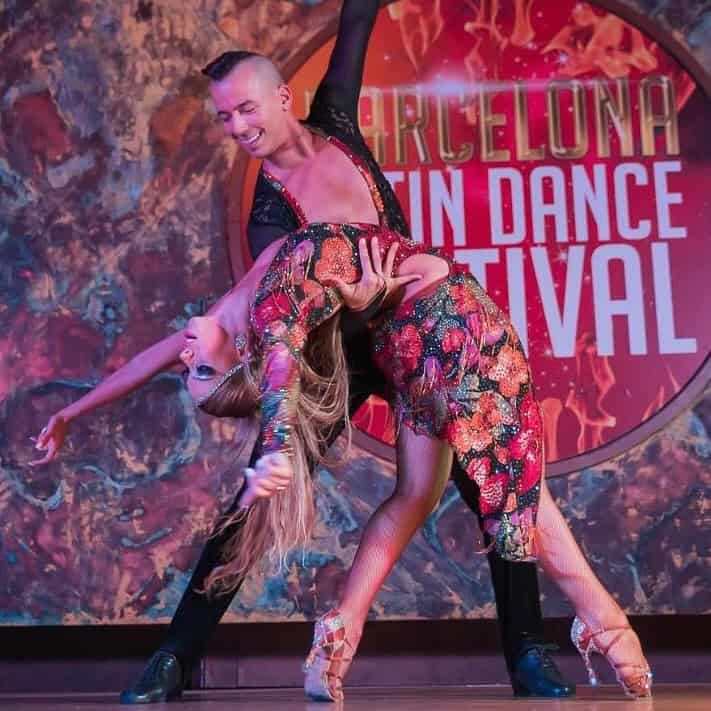

ADRIÁN Y ANITA at a glance
- Stage name: Adrián y Anita (also written Adrian y Anita or Adrian & Anita)
- Names: Adrián Rodríguez Carbajal and Anita Santos Rubín
- Origins: Anita, born in Ponta Grossa (Paraná, Brazil) 🇧🇷 [1] · Adrián, born in Montevideo (Uruguay) 🇺🇾 [2]
- Home base: Barcelona, Spain 🇪🇸 [2]
- Stage partners: Adrián danced with Sabrina Kacheroff (Spanish champions in 2004), then with Sandra García (2005); Adrián and Anita have danced together since 2005 [3]
- Teams: Johnny Vázquez’s Imperio Azteca (Adrián, 2005) · Amateur Salsa Company (2011) · World Team Project (2015) [2][3][4]
- Style: Linear Salsa, ladies’ styling, Bachata [5]
- Competition results: 🥇 Puerto Rico 2007, 2008 and 2011 · 🥇 Greece 2008 and 2009 (according to them) · 🥇 World Salsa Masters, Madrid, November 7, 2014 · second place twice and third place once in Puerto Rico (2006, 2009, 2010) [2][6]
- Television: Mira Quién Baila, five years, on TVE and then on Telecinco [1]
- Countries visited: 57, according to their 2021 count [7]
- Status: touring every weekend; Anita’s schedule fully booked until 2026 (August 2024) [8]
Adrián y Anita, six-time world Salsa champions
She comes from Ponta Grossa, in Brazil, and from classical ballet. He comes from Montevideo, in Uruguay, and from music. Together, Adrián y Anita won six world championship titles in Salsa, from 2007 to 2014.
Their path has been anything but straight: a car accident, a disbanded ballet company, a congress stage in Tarragona, ten years of competition. They talk about it themselves, and here they tell it in their own words.
About this article
The article published in 2018 has been rewritten and corrected: it follows the lives of Adrián y Anita in order, from Ponta Grossa and Montevideo to today, with their own words at every stage. The facts come from their interviews, their statements, the press, and competition archives. The numbers in square brackets refer to the notes at the bottom of the page.
Last updated: October 2026.
Contents
- True or False: Examining the 8 Myths About Adrián y Anita
- Ponta Grossa and Rio, before 2000: ballet, a late dream, an unused scholarship
- Rio then Galicia, around 2000: an accident, an operation, a country that makes her stay
- Zaragoza, until 2005: the Ballet de Zaragoza
- Zaragoza: a bar where she thinks she hears samba
- Montevideo: music at home, a strategy for the girls
- Terrassa and Barcelona, 2002-2004: Buenavista and a Spanish title
- 2005: Imperio Azteca, Johnny Vázquez’s company
- Tarragona, 2005: a congress, a stage, a promise
- Barcelona, 2005-2006: the duo takes shape, television
- Puerto Rico, 2006-2011: second place, then three-time winners
- Athens, November 2008, and Greece: two titles, according to them
- Fall 2011: the Amateur Salsa Company
- 2015: the World Team Project
- Madrid, November 7, 2014: the sixth title
- After Madrid: the end of competition, “Como yo te amo”
- 2020-2022: lockdown, online classes, Barcelona
- Today: still on the road
- Their method: ladies’ styling, men’s styling, social dancing
- What they say about themselves: consistency, humility, sacred work
- In summary: the journey of Adrián y Anita
- Studio24’s artistic references
- Learning Salsa in Liège and online
- FAQ: all about Adrián y Anita
- Sources and bibliography
“Gracias a Dios por el accidente me vine a España, así que hoy sé que fue algo positivo al final.” (Thank God for the accident: I came to Spain, and today I know that, in the end, it was something positive.) This is what Anita Santos Rubín says about the car accident that took her from Brazil to Spain, in an interview on the channel Novios que bailan [9].
A Brazilian trained in classical ballet, a Uruguayan who came from music and nightclubs: Adrián y Anita meet in Tarragona in 2005 and have danced together ever since. From 2007 to 2014, they win six world Salsa championship titles. Even today, they travel from one festival to another every weekend [10].
Their story is surrounded by phrases that circulate everywhere: champions in Atlanta, six-time World Salsa Masters champions, Puerto Rico champions as early as 2006, National Ballet of Zaragoza. Some are false; others need clarification. It is best to start there, then follow their journey in order: two paths, a meeting, titles, injuries, a life on stage that continues.
Atlanta, National Ballet, “romantic”? The 8 MYTHS About ADRIÁN Y ANITA, TRUE or FALSE
Before telling their story, a necessary stop. Biographies of Adrián y Anita circulate on festival websites, dance websites, and fan pages, copied, exaggerated, sometimes false. Eight claims keep coming up. Which ones stand up to scrutiny? The verdict at a glance, then the details in the sections indicated.
❌ MYTH 1 · World Champions in Atlanta?
They are said to have been world champions in Atlanta in 2016
✅ False — Atlanta has nothing to do with their titles. Their sixth title is the one from Madrid, on November 7, 2014.
❌ MYTH 2 · Six-Time World Salsa Masters Champions?
They are said to have won the World Salsa Masters six times
✅ False — they won it once, in Madrid in 2014, at its first edition. Their six titles come from three competitions.
❌ MYTH 3 · Puerto Rico Champions as Early as 2006?
They are said to have won in Puerto Rico as early as 2006
✅ False — in 2006, they finish second. Their first title dates to 2007.
❌ MYTH 4 · Two-Time World Champions in Greece?
World champions in Greece, in 2008 and 2009
✅ Needs clarification — that is what they claim. Only their win in Athens, in November 2008, has an external record.
❌ MYTH 5 · The National Ballet of Zaragoza?
Anita is said to have joined the National Ballet of Zaragoza
✅ Needs clarification — that is the name in their biographies. The company was called the Ballet de Zaragoza; it was run by the city and disbanded in 2005.
❌ MYTH 6 · In Spain by 2000, in the Ballet That Same Year?
Anita is said to have settled in Spain in 2000 and joined the ballet that same year
✅ Needs clarification — she arrives around 2000 for an operation. Ballet comes several years later.
❌ MYTH 7 · A Scholarship From the Laban Center?
Anita is said to have received a scholarship to London’s Laban Center
✅ Needs clarification — she does win a scholarship to a school in London, but cannot go, because she lacks the money. She does not name the school.
❌ MYTH 8 · Romantic and Refined?
A romantic, refined style, mesmerizing choreography
✅ Needs nuance — in 2015, they describe shows as “acrobáticos y muy rápidos” (acrobatic and very fast). For Anita, the “romantic” one is a specific show: Como yo te amo.
PONTA GROSSA and RIO, before 2000: BALLET, a late dream, an unused scholarship
Anita Santos Rubín was born in Ponta Grossa, in the state of Paraná, Brazil, into a humble family [1]. As a child, she dreams of dancing, but money is short. “Siempre quise estudiar baile pero no había dinero” (I always wanted to study dance, but there was no money) — Anita, La Salsa de Cuba [11].
The turning point comes at her school, which introduces free ballet classes. “ya fue como un mundo nuevo para mí, empecé tarde, pero ya mi vida cambió” (it was like a new world for me: I started late, but my life changed) — Anita, Almería24hTV [10]. From the first classes, she knows: “vi que el baile era lo mío” (I saw that dance was for me) [11]. Her teacher advises her mother to send her to the conservatory; there, she studies classical ballet, contemporary dance, and jazz [1][10].
To continue, she leaves her hometown to study in Rio de Janeiro, where the municipal theater’s school has a good reputation [3]. A dance seminar in Brazil awards scholarships. Anita wins one, for a school in London. She cannot go: “había otros gastos, entonces al final no fui” (there were other expenses, so in the end I did not go) [11]. She feels no bitterness about it: “al final se dio todo de esa manera y al final estoy aquí” (in the end everything happened that way, and in the end I am here) [11].
RIO then GALICIA, around 2000: an accident, an operation, a country that makes her stay
In Rio, Anita is in a car accident. She has surgery on her arm: “tengo este brazo operado tengo seis tornillos, tengo una placa” (I have had surgery on this arm, I have six screws, I have a plate) [11]. Her father is Galician and her mother Brazilian [3]: so she goes to Galicia for surgery, intending to return. “mi idea realmente era operarme y volver, pero llegué, vi todo eso en Galicia. La tranquilidad, la tranquilidad. Sí, y ya me quedé” (my idea really was to have surgery and return, but I arrived, I saw all that in Galicia. The peace, the peace. And I stayed) — Anita [11].
From the accident to her recovery after surgery, it takes her a year [12]. She then lives in Pontevedra, starts working in an orchestra [3] and stays there for about three years [12]. Of her surgeon, she says: “gracias a él he podido volver con mi vida, he podido volver a bailar” (thanks to him I was able to get my life back, I was able to dance again) [12].
When does all this happen? Around 2000, she answers, uncertainly: “más o menos bien el 2000” (around the year 2000) [13]. She lays out her timeline: a year incapacitated, about three years in Pontevedra, then ballet [12].
ZARAGOZA, until 2005: the BALLET de Zaragoza, six selected, then closure
While she is in Pontevedra, a teacher at the nearby dance school encourages her to audition for the ballet de Zaragoza [12]. There are many applicants: “éramos creo que 200 y pico y han cogido a 6” (there were, I think, more than 200 of us and they took six) — Anita, Franco Rocha [12]. She counts that day among the happiest of her life: “lo pongo como uno de los días más felices de mi vida” (I rank it as one of the happiest days of my life) [12].
She stays with the company for about three years [12]. It is a municipal company: the ballet is run by the city council [12][14]. One day, a colleague asks her: “¿Has visto el periódico?” (have you seen the newspaper?) [12] The city disbands the company, which will be replaced by an Aragonese jota ensemble [3].
The loss still hurts: “siento que era mi primera pasión y aunque la bailé mucho y tal, siento también que me lo quitaron” (I feel it was my first passion and, even though I danced it a lot, I also feel it was taken away from me) — Anita, Novios que bailan [9]. At the same time, an Achilles tendon injury prevents her from attending other auditions [9]. She no longer knows what to do [3]. But she still has Salsa, which she has just discovered: “tengo la salsa, que es algo nuevo que me gusta, que acabo de conocer” (I have Salsa, which is something new that I like, that I have just discovered) [9].
ZARAGOZA: a bar where she thinks she hears samba
A friend tells her about a bar that plays music from her country, samba. It is not samba: it is Salsa [12]. “Fíjate que yo no sabía la diferencia entre salsa y samba” (imagine, I did not know the difference between Salsa and samba) — Anita [10].
What strikes her is the atmosphere. “me gustó la alegría, me gustó la música” (I liked the joy, I liked the music) [9]. After ballet, where “en ballet clásico es todo muy serio, muy riguroso” (in classical ballet everything is very serious, very rigorous) [10], she discovers a dance where people smile. She goes back every week, with one goal: “mi objetivo era entender lo que el chico me hacía” (my goal was to understand what my partner was leading me to do) [9]. Then: “me enamoré de la salsa” (I fell in love with Salsa) [9].
Yet the passion does not come all at once. Anita admits: “los primeros años fueron como que lo hacía, pero no era esa pasión” (in the first few years, I did it, but it was not that passion) [11]. She joins three groups at once, in Zaragoza [3], and discovers Salsa congresses, where artists from all over the world come to dance, in Sitges [3].
MONTEVIDEO: music at home, a strategy for the girls
Adrián Rodríguez Carbajal is born in Montevideo, Uruguay. As a child, he gets involved in music and never leaves it behind [2]. At home, it is everywhere: his father is a devoted fan of Eddie Palmieri and Rubén Blades, and his grandfather carefully keeps vinyl records by Celia Cruz and la Sonora Matancera [2]. Adrián himself remembers his grandfather’s record: “creo que eso fue el comienzo por donde empezó a entrar con esa música” (I think that was the beginning, when this music started to find its way into me) — Adrián, Salsero en la ciudad [3].
Dance comes into his life in a different way. “fue una estrategia para acercarme a las chicas” (it was a strategy to get closer to girls) — Adrián [3], he says with a laugh. Then the strategy takes on a life of its own: he rehearses day and night. “dejé todo por bailar, bailar, bailar bailar” (I gave everything up to dance, dance, dance) [3].
Self-taught, he gets his start in his city’s nightclubs. In just over a year, according to his biography, he becomes a “personaje de la salsa” (Salsa figure) in his country [2].
TERRASSA and BARCELONA, 2002-2004: a Colombian bar, the BUENAVISTA nightclub, a Spanish title
Adrián arrives in Spain in 2002: “yo me vine en el 2002” (I came in 2002) [3]. He first lives in Terrassa, near Barcelona, and works in a Colombian bar: “empecé a trabajar limpiando copas” (I started working by cleaning glasses) [3]. People dance differently there than in Uruguay, and they give him funny looks [3].
A month later, he leaves for Barcelona with the intention, their biography says, of “formarse y vivir de su pasión” (training and making a living from his passion) [2]. He goes to the nightclub that was, he says, “el templo de la salsa en Barcelona” (the temple of Salsa in Barcelona) [3]. Having left Terrassa with ten euros in his pocket, he finds a way in and leaves that same evening with a job: he collects glasses, leads entertainment activities, then serves mojitos [3]. “Ese mismo día yo salí con trabajo de ahí” (that very day, I left there with a job) [3].
In 2004, he forms a duo with an Argentine dancer, Sabrina Kacheroff. “quedamos campeones de España en el salsa open en el 2004” (we became Spanish champions at the Salsa Open in 2004) — Adrián [3]. She is his first title-winning partner.
2005: IMPERIO AZTECA, JOHNNY VÁZQUEZ’s company
The following year, Adrián dances with another partner, Sandra García. They finish second in the Spanish championship, but, he says, “no funcionó” (it didn’t work out) [2][3].
That same year, 2005, Johnny Vázquez, “the Prince of Salsa,” invites him to join his company, Imperio Azteca. Adrián travels with it for a year, from one international event to the next [2]. His biography describes Johnny Vázquez and Ramón Morales as two fundamental parts of his artistic training [2].
Adrián himself acknowledges his debt: “es una persona que a mí me ha inspirado mucho y he aprendido mucho de Jhonny Vázquez” (he is someone who has inspired me a great deal and from whom I have learned a lot, Johnny Vázquez) — Adrián [3]. His own style, he adds, is “una mezcla de Jhonny con Jason” (a mix of Johnny and Jason) [3], referring to Jason Molina, with whom he has also danced.
TARRAGONA, 2005: a congress, a stage, a promise
At the Salsa congress in Tarragona in 2005, Anita takes the stage with one of the groups she joined a few months earlier in Zaragoza, a couples group [3][12]. Adrián watches her. “esa chica tiene que bailar conmigo” (that girl has to dance with me) — Adrián [3]. It is not yet her technique that strikes him: “Ella no era que bailaba pero tenía un saber estar, una planta en el escenario” (she wasn’t really dancing yet, but she had presence, poise on stage) [3].
Anita tells the same story in her own way. Adrián introduces himself: “Soy Adrián Rodríguez, campeón de España y tal” (I’m Adrián Rodríguez, Spanish champion and all that) — Anita, Franco Rocha [12]. He tells her she has potential: “creo que tienes potencial” (I think you have potential) [12]. She smiles at his confidence: “qué seguridad tienes el chico” (what a confident guy) [12].
He also makes her a promise: “yo te prometo que te haré campeona de España” (I promise you I’ll make you a Spanish champion) — Anita, Mi Pasión [13]. Competition is there from the start: “fue competencia desde el primer momento” (competition was there from the very first moment) [13].
Anita has more than one offer. She starts rehearsing with another dancer, Gregory Campillo, then Johnny Vázquez invites her to come to Italy to form a duo [12]. She hesitates between three paths [12]. Johnny is the Prince of Salsa: “siento que no estoy preparada para bailar con él. Siento que necesito aprender” (I feel I’m not ready to dance with him. I feel I need to learn) [8]. She has always seen Adrián as “una persona muy emprendedora, una persona que tenía mucha ambición por competir” (a very enterprising person, someone with a great deal of ambition for competition) [8]. She chooses Adrián [12].
BARCELONA, 2005-2006: the DUO takes shape, television, first victories
Anita moves to Barcelona to rehearse with Adrián [9]. Adrián recalls: “a los cinco meses empezamos a bailar juntos” (five months later, we started dancing together) [7]. And what followed: “Empezamos a bailar y fue guau” (we started dancing and it was wow) — Adrián, Más allá del triunfo [7]. Anita places this beginning “a final de 2005” (at the end of 2005) [3].
In the first few weeks, they enter a qualifying round of the World Salsa Championship in Göteborg, Sweden. Adrián places it “quince días después de comenzar a bailar” (fifteen days after we started dancing) [3]. They win, but he does not have a visa for the United States, where the final is held. The next day, a televised charity gala, then Mira Quién Baila calls them back: the show wants to add Salsa to its rhythms [3].
They will stay there for five years, first on TVE, then on Telecinco [1][3]. Anita teaches Salsa to celebrities there without mastering the figures herself: “yo tenía que apuntar en una chuleta, cross body” (I had to write it down on a cheat sheet, cross body) — Anita [3]. Still, she draws a conclusion from it: “pero también fue una escuela para mí” (but it was also a school for me) [3].
At first, they work at festivals for free, paying for their own travel and hotels, to make a name for themselves [3]. “hemos hecho un año entero gratis para que la gente nos conociera” (we worked for a whole year for free so people would get to know us) — Anita [3].
Anita also speaks frankly about what their first year was like. They were initially a couple in their personal lives: “Adrián y yo fuimos parejas el primer año y después de eso nos separamos y tuvimos dos años mal” (Adrián and I were a couple the first year, then we broke up and had two difficult years) — Anita, Mi Pasión [13]. Elsewhere, she says “tuvimos otros dos años muy mal” (we had another two very bad years) [8]. Yet they continued to work together [8].
What kept them going, according to her: “pesó mucho el trabajo en el sentido de poner el trabajo en primer lugar y decir esta pareja funciona, es algo que realmente nos da la vida, el trabajo nos da la vida, vamos a seguir” (work carried a lot of weight, in the sense of putting work first and saying: this duo works, it’s something that truly gives us life, work gives us life, we’re going to keep going) — Anita, ANOVE TV [8]. Today, she puts it simply: “somos hermanos prácticamente y como mucha gente piensa que somos pareja, no somos pareja” (we are practically brother and sister and, since many people think we are a couple, we are not a couple) [8]. They have been dancing together since 2005 [8].
PUERTO RICO, 2006-2011: second place, then three WORLD SALSA OPEN wins
Since 2006, their press releases say, they have represented Spain in major international competitions [2]. Their first major contest is at the Salsa congress in Puerto Rico that year: they finish second [15][16]. Anita: “quedamos segundos y al segundo año ya quedamos primeros” (we came second and in the second year we came first) [8]. That second place already meant a great deal to her: “para mí ya fue una cosa como ganar” (for me, it was already a kind of victory) [9].
In late July 2007, in San Juan, they win. A forum post dated August 1, 2007, announces: “THE WINNERS OF THE PUERTO RICO SALSA CONGRESS ARE FROM SPAIN, MUNDIAL SALSA OPEN 2007: Anita Santos y Adrian Rodriguez” (the winners of the Salsa congress in Puerto Rico are from Spain, Mundial Salsa Open 2007: Anita Santos and Adrian Rodriguez) [17]. They win again in 2008 [18][19], then in 2011: their website then proclaims “Penta-campeones mundiales de salsa” (five-time Salsa world champions) [20]. Before that final, the press presents them as “los campeones de las ediciones 2007 y 2008” (the champions of the 2007 and 2008 editions) [21].
In between, they reach the podium without winning. Adrián, in June 2011: “Hemos perdido también tres campeonatos. Hemos quedado dos veces subcampeones y una vez terceros” (we have also lost three championships: we have come second twice and third once) [22]. And Anita: “Siempre tuvimos podios, eso sí” (we have always had podium finishes, that’s for sure) [8].
In a December 2011 interview, the duo says the first victory remains the most beautiful: “la primera vez, yo creo que la que nunca se te olvida” (the first time, I think that’s the one you never forget) [23], built on “mucho sudor que pusimos ahí en la sala de ensayo” (a lot of sweat shed in the rehearsal room) [23].
Anita does not hide the cost: “todos los días llorando, todos los días estresada, todos los días pasándolo mal” (crying every day, stressed every day, feeling bad every day) — Anita, Franco Rocha [12]. Their ritual before a contest: wait for the party to end, then rehearse on the actual stage. “Esperábamos la fiesta del social acabar, como las 3, 4 de la mañana, y a las 4 y media de la mañana íbamos a ensayar, que no había nadie” (we waited for the social dance party to end, around 3 am or 4 am, and at 4:30 am we went to rehearse; there was no one there) [9].
ATHENS, November 2008, and GREECE: two world titles, according to them
They also announce two world championship titles in Greece, in 2008 and 2009. That is what their press releases say: “dos campeonatos mundiales en Grecia (2008-2009)” (two world championships in Greece (2008-2009)) [2]. And what they repeat in December 2011: “ganamos, como tú dijiste, tres veces en Puerto Rico y dos veces en el Mundial de Grecia” (we won, as you said, three times in Puerto Rico and twice at the World Championship in Greece) [23].
There is an external record for Athens: a video presents “The winners of the competition – First Todo Latino Salsa Festival – Athens, Nov 2008” (the winners of the contest, first Todo Latino Salsa Festival, Athens, November 2008) [24].
FALL 2011: the ADRIAN Y ANITA AMATEUR SALSA COMPANY
In 2011, they launch an amateur company that bears their name. The first audition takes place in Seville on September 30, with forty candidates. Another is announced in Valladolid for October 21, with Franco Rocha as deputy director, to select twenty dancers from seventy registered applicants. Seville and Valladolid are to host the first two companies outside Barcelona, and Bucharest a fourth [4].
These are busy months. In a December 2011 interview, the duo explains: “no es fácil congeniar las clases, también trabajamos en un programa de televisión en España y entonces conciliar un poco los ensayos, los entrenos fue bastante difícil” (it’s not easy to juggle classes; we also work on a television show in Spain, so fitting in rehearsals and training was quite difficult) [23].
2015: the WORLD TEAM PROJECT, a network of teams
In the spring of 2015, Adrián presents a project he runs with Anita: the World Team Project. He calls it “la red de baile más grande del mundo” (the largest dance network in the world) — Adrián, Salsero en la ciudad [3], and gives his figures: “tenemos como ciento veinte equipos en quince países” (we have about one hundred and twenty teams in fifteen countries) [3]. These are his own figures, from 2015.
The idea: coaches trained by them build teams using their choreography and videos, keeping in direct contact with the duo through social media. The network also brings together the teams of Daniel y Desirée and those of Johnny Vázquez [3]. Anita explains that Adrián handles most of it [3]. Their school in Barcelona is then called New Dance Center [3].
Anita describes this teamwork as follows: “teníamos una compañía de baile y de esa compañía salían muchas parejitas” (we had a dance company, and many little duos emerged from that company) — Anita, Novios que bailan [9].
MADRID, November 7, 2014: the SIXTH TITLE, at the WORLD SALSA MASTERS
On Friday, November 7, 2014, in Madrid, sixteen duos from many countries compete in the first edition of the World Salsa Masters, as part of the Madrid Salsa Festival. Entry required an international title or an outstanding professional track record [6]. Adrián y Anita win first prize and the audience award. The press writes: “Con este título ya suman seis campeonatos internacionales en su haber” (with this title, they already have six international championships to their name) [6].
The jury awards them 825 points and 7 000 euros. They share the audience award, 2 500 euros, with the other fifteen duos [2].
Immediately afterward, both are “una mezcla de pues nerviosos, felices, eufóricos” (a mix of nervous, happy, euphoric) [25]. They spent six to seven months on the choreography: “tres, cuatro horas todos los días y los últimos meses de domingo a domingo” (three, four hours every day and, in the final months, from Sunday to Sunday) [25]. The standard was very high, and they like that: “nos gusta competir con gente así” (we like competing with people like that) [25]. Anita, for her part, is tired: “Son como nueve años que yo digo es el último” (for about nine years now, I’ve been saying: this is the last one) [25].
Anita sums it up: “hemos ganado seis veces” (we have won six times) — Anita, ANOVE TV [8].
The Adrián & Anita Methodology – World Mastery Certification
If you too want to discover this art of sensuality, feel free to join our Salsa L.A. classes certified by Adrián & Anita, 6x world champions (World Mastery certification).
AFTER MADRID: the end of COMPETITION and “COMO YO TE AMO”
After Madrid, they stop competing. “Hemos competido una vez más en Madrid, en un mundial que hubo en Madrid. Y después sí que ya no competimos” (we competed once more in Madrid, in a world championship held in Madrid. And after that, no, we didn’t compete anymore) — Anita, Mi Pasión [13]. She then counts “eran 10 años compitiendo” (ten years of competition) [9].
Their plan was to become judges: “nuestra idea era después de competir, llegar a ser jueces” (our idea was to become judges after competing) [8]. But, Anita says, “algo muy fuerte pasó una cosa muy injusta y no quiero entrar demasiado del tema” (something very intense happened, something very unfair, and I don’t want to go into the subject too much) [8]. She does not say which competition it was.
In 2015, they themselves announce a change of direction: “ese tipo de shows toda la vida, acrobáticos y muy rápidos” (that kind of show all our lives, acrobatic and very fast) — Anita, Salsero en la ciudad [3]. They want to “bailar un poquito más suave, bailar un poquito más tranquilos para poder congeniar eso con un poco de vida” (dance a little more gently, a little more calmly, to balance that with a bit of a life) [3].
Then comes a slow show, the complete opposite of what they used to do: “un show como muy lento, todo al revés de lo que hacíamos” (a very slow show, the complete opposite of what we used to do) [8]. It is the one with the blue costume, Como yo te amo. Anita calls it “la romántica” (the romantic one) [9] and says of it: “es un show como muy emotivo y es un show como contando un poco nuestra historia las dificultades que tuvimos” (it’s a very moving show that tells a little of our story, the difficulties we had) [8]. According to her, it is the show for which the audience has given her the most affection in return [9].
Anita has paid for this career with her body. At the premiere of this show, she fractures her wrist during a lift; she keeps dancing, then cannot move her hand for three months [8]. She has also danced with a broken foot, a bone beneath her big toe broken into three pieces [9]. “siempre he tenido que bailar lesionada” (I’ve always had to dance injured) [9]. What she finds worst about her profession: “que no me puedo enfermar” (not being able to get sick) [8].
2020-2022: LOCKDOWN, online classes, BARCELONA in the spotlight
When events stop in 2020, Anita teaches more online classes on her own [9]. In the fall of 2021, they say they have danced in “creo que en 57 países” (I think, in 57 countries) [7].
On May 13, 2022, Fania dedicates the fourth episode of its series Salsa Around the World to Adrián y Anita: they dance to “Ponte Duro,” by Roberto Roena y su Apollo Sound, in front of the Sagrada Família and the Agbar towers in Barcelona [26].
TODAY: still on the ROAD, and in BARCELONA
In an interview posted online in November 2025, Anita says: “llevamos 20 años viajando cada fin de semana” (we’ve been traveling every weekend for 20 years) [10], and adds: “y entre semana damos clases en nuestra escuela en Barcelona y yo también tengo online” (and during the week we teach classes at our school in Barcelona, and I also teach online) [10].
In August 2024, her schedule is full: “hasta 2026 ya no hay ninguna horita para privadas, ningún domingo, nada libre” (there are no more slots for private lessons until 2026, not a single free Sunday) [8]. She has created a new show in which she plays timbales: “todavía yo no había visto a una chica que había bailado y tocado un instrumento” (I had never yet seen a girl who had danced and played an instrument) [8]. In the future, she plans to stay in dance, but “en menos intensidad y menos viaje” (with less intensity and less travel) [8].
Adrián, for his part, goes by “Papito Control”: that is the name of his personal Instagram account. “la mía que es Papito Control” (mine is Papito Control), he says [7].
And the partner dancing continues. Anita, August 2024: “a Adrián, mi pareja de baile de 20 años” (to Adrián, my dance partner for 20 years) [8].
Their METHOD: feminine styling, masculine styling, SOCIAL DANCING
Their press releases present them as headliners at events around the world, with “espectáculos llenos de energía y siempre innovadores” (shows full of energy and always innovative) [2] They add that their master classes, with their own techniques and styles, have helped thousands of Caribbean rhythm enthusiasts. This is how they present themselves. In 2015, their workshops focus on lady’s style (feminine styling) and men’s style (masculine styling) [3].
Each has a role. Anita: “Adrián siempre es la cabeza pensante de toda la coreografía” (Adrián is always the mind behind all the choreography) — Anita, Franco Rocha [12]. He also designs all the costumes [12]. Anita prefers the other side of the work: “me encanta el trabajo de limpieza de coreografía” (I love the work of cleaning up the choreography) [9].
Social dancing is part of the job. “Pienso que un bailarín debe de ser completo” (I think a dancer should be well-rounded) — Anita [13]. She tells students “saquen a las bailarinas y bailen despacito, disfrutando con la música” (ask the female dancers to dance and dance slowly, enjoying the music) [27]. And at congresses: “para nosotros es imposible ir a congreso e irnos a dormir a la habitación” (for us, it’s impossible to go to a congress and head off to sleep in our room) [3].
What they say about THEMSELVES: consistency, humility, sacred work
For Anita, what matters is not talent. “Ni el talento, ni las facilidades físicas, ni lo guapo que seas, constancia” (neither talent, nor physical aptitude, nor your beauty: consistency) — Anita, Franco Rocha [27]. And about herself: “no creo que sea talentosa creo que soy trabajadora” (I don’t think I’m talented, I think I’m hardworking) [9].
Her mother is what keeps her going: “Mi mamá es mi fortaleza, mi mamá es mi alegría, mi mamá es mi impulso para hacer las cosas” (my mother is my strength, my mother is my joy, my mother is my drive to do things) — Anita, ANOVE TV [8].
Humility too: “nadie es más que nadie” (no one is above anyone else) [9]. Work is “sacred”: “tomamos el trabajo como algo sagrado” (we treat work as something sacred) — Anita [3]. She says it plainly: “yo trabajo de lunes a lunes no tengo un día libre” (I work from Monday to Monday, I don’t have a single day off) [10].
What she loves about this life is social dancing: “bailo con uno que habla español, con el otro que es chino” (I dance with one person who speaks Spanish, with another who is Chinese) [9].
Their strengths complement each other. Anita: “él es como el genio de la mente innovadora para coreografías, para vestuarios y yo tenía un poco más lo que es la constancia del trabajo, de la disciplina del ballet” (he’s like the genius with the innovative mind for choreography, for costumes, and I had a bit more of the consistency in work, the discipline of ballet) [10]. In 2015, Adrián talks about their balance: “ninguno tira de ninguno” (neither pulls the other) — Adrián [3], “vamos los dos palante siempre” (we both move forward, always) [3].
In SUMMARY: Adrián y Anita’s journey
Eight milestones mark their journey.
- Who they are: a Brazilian from a classical ballet background and a Uruguayan from a music background, based in Barcelona.
- Their meeting: Tarragona, 2005, at a Salsa congress.
- Their beginnings: five years on Mira Quién Baila, on TVE and then on Telecinco.
- Six titles: Puerto Rico 2007, 2008 and 2011; Greece 2008 and 2009 (according to them); World Salsa Masters, Madrid, November 7, 2014.
- After 2014: the end of competitions and a slow show, Como yo te amo.
- Their teams: Imperio Azteca (Adrián, 2005), Amateur Salsa Company (2011), World Team Project (2015).
- Today: travel every weekend, a school in Barcelona, online classes.
- What they have not done: become champions in Atlanta, or win the World Salsa Masters six times.
Studio24’s artistic REFERENCES
Adrián y Anita’s path crosses those of masters featured by Studio24. Johnny Vázquez first: Adrián dances in his Imperio Azteca from 2005 onward, and Anita calls him “nuestro maestro” [27]. She says of him: “Para mí es el príncipe ayer, hoy, mañana es el creador de un estilo único” (for me, he is the prince yesterday, today, tomorrow, the creator of a unique style) [13].
Daniel y Desirée next: their teams are part of the World Team Project, according to Adrián [3]. Fernando Sosa finally: Adrián names him among the dancers he admires, with these words, “mi tocayo, Fernando Sosa” (my namesake, Fernando Sosa); Anita, for her part, names Tropical Gem [3].
All the blog’s profiles are gathered on the page about the great names of Salsa, Mambo and Bachata.
Learning SALSA in Liège and online
Studio24 offers group Salsa classes in Liège with Xavier Colina. Whether you’re in Liège or anywhere in the French-speaking world, Studio Live lets you get started at your own pace, through video.
Want to dance Salsa?
🎓 Xavier teaches Salsa at Studio24 in Liège. Or online anywhere in the world through Studio Live.
FAQ: everything about ADRIÁN Y ANITA
🌎 Who are ADRIÁN Y ANITA?
Adrián y Anita are a Salsa dance duo based in Barcelona. Anita Santos Rubín was born in Ponta Grossa, Brazil, and comes from a classical ballet background. Adrián Rodríguez Carbajal was born in Montevideo, Uruguay. They have danced together since 2005 and hold six world championship titles, from Puerto Rico 2007 to Madrid 2014. They travel from one festival to another every weekend.
✍️ Adrián y Anita or Adrian y Anita: how is it spelled?
Both spellings are used: with an accent, Adrián y Anita, or without an accent, Adrian y Anita or Adrian & Anita. The first name is spelled Adrián in Spanish.
🥇 How many TITLES have they won?
Six: three in Puerto Rico (2007, 2008, 2011), two in Greece (2008 and 2009, according to their press releases), and the World Salsa Masters in Madrid on November 7, 2014. Before the 2011 final, they had also placed second twice and third once in Puerto Rico. There is no title in Atlanta in 2016.
🏆 What is the WORLD SALSA MASTERS?
A championship held in Madrid as part of the Madrid Salsa Festival. Its first edition took place on Friday, November 7, 2014, with sixteen duos who held an international title or had a remarkable track record. Adrián y Anita won it, along with the audience award.
🤝 Who do they DANCE WITH on stage?
Together: they have been a single duo since 2005. Before that, Adrián had danced with Sabrina Kacheroff, with whom he became Spanish champion in 2004, then with Sandra García in 2005; he also traveled for a year with Johnny Vázquez’s Imperio Azteca. Anita also teaches bootcamps on her own [28].
📍 WHERE DO THEY TEACH today?
In Barcelona and at festivals. Anita talks about their school in Barcelona, where they teach during the week, and about her online classes [10].
🌍 In how many COUNTRIES have they danced?
They say 57 countries in 2021, with an “I think.” Their 2014 press releases and Fania’s introduction in 2022 mention more than 40 countries.
📺 What is their connection to MIRA QUIÉN BAILA?
They taught Salsa to celebrities on the show for five years, first on TVE and then on Telecinco.
🌐 What is the WORLD TEAM PROJECT?
A network of dance teams presented by Adrián in 2015: according to him, around one hundred and twenty teams in fifteen countries, including the teams of Daniel y Desirée and Johnny Vázquez.
🏛️ NATIONAL BALLET of Zaragoza: what is its real name?
Anita’s company was called the Ballet de Zaragoza; it was run by the city and ceased to exist in 2005. “Ballet Nacional de Zaragoza” is the name given in their biographies.
🛑 Why did they STOP competing?
After Madrid in 2014, they no longer competed. Anita talks about ten years of competition and something very unfair at a competition she does not name.
🎓 Want to dance SALSA? Where should you start?
With a trial class at Studio24 in Liège, or online with Studio Live.

About the author
Xavier Colina teaches Salsa On1, Mambo On2, and Bachata at Studio24 in Liège (Belgium) and online through Studio Live. Trained in the direct lineage of Eddie Torres → Adolfo Indacochea (World Mastery program), Fernando Sosa and Korke y Judith. Learn more →
Sources & Bibliography
- ↩ Anita Santos Rubín’s official website : ANITA SANTOS RUBÍN. “Bio” [online]. anitasantosrubin.com. Available at: https://anitasantosrubin.com/es/bio/ [accessed October 25, 2026]. Note: Anita says there that she was born in Ponta Grossa (Paraná), comes from a humble family, trained in classical ballet, contemporary dance, and jazz, and worked for five years on Mira Quién Baila, first on TVE and then on Telecinco.
- ↩ November 2014 press release (biographies supplied by the duo) : ETER. “Los bailarines afincados en España Adrián y Anita, nuevos Campeones del Mundo de Salsa” [online]. November 9, 2014. Available at: https://www.eter.com/actualidad/noticia.php?id=17099 [accessed October 25, 2026]. Note: the text contains the duo’s official biographies. Anita’s mentions a scholarship to the “Laban Center” in London, her arrival in Spain in 2000, and her joining the “Ballet Nacional de Zaragoza” that same year. Adrián’s dates his departure for Barcelona to 2004. The article is dated November 9, 2014, and says “Anoche”: the Madrid championship began around 11:30 pm on Friday, November 7, and lasted almost three hours.
- ↩ Salsero en la ciudad, April 2015 : GARCÍA, Paco. “Entrevista a Adrian y Anita, energía, constancia, humildad…”. Salsero en la ciudad [online]. April 22, 2015. Available at: https://www.salseroenlaciudad.com/entrevista-a-adrian-y-anita-energia-constancia-humildad/ [accessed October 25, 2026]. Note: cited chapters of the recording: [02:10], [03:40], [05:30], [07:30], [08:50], [10:20], [13:50], [16:00], [17:30], [19:20], [21:55], [23:05], [25:25], [26:36], [29:25], [31:40]; a 42-minute audio interview recorded at the Elchesalsea congress (Elche); the chapters on the page give the time for each topic. On when they met, Adrián first says “en el 2006 en un congreso en Tarragona veo a Anita en el escenario”; when asked “2005 o 2006,” Anita replies “eso fue a final de 2005” and Adrián confirms “2005.” The official biography says 2005. On his arrival, Adrián corrects the interviewer (“te viniste para acá en el 2004”): “yo me vine en el 2002”; the official biography dates his departure for Barcelona to 2004. On the date of their first competitions, Adrián mentions “quince días después de comenzar a bailar” (Gothenburg qualifying round), Anita “ocho meses” (Novios que bailan, [13:09]).
- ↩ The duo’s former website, 2011 (archived copy) : ADRIAN Y ANITA. “Sevilla y Valladolid ya tienen su “Adrián y Anita Amateur Salsa Company”” [online]. adrianyanita.com, 2011. Archived October 27, 2011 (page no. 89). Available at: https://web.archive.org/web/20111027174550/http://www.adrianyanita.com/aya/index.php?option=com_k2&view=item&id=89&lang=es [archive accessed October 25, 2026]. Note: the page does not give a year; it is part of the same 2011 website, copied on October 27, 2011, and announces auditions in Valladolid on October 21.
- ↩ Dance directory listing : SALSERO.ES. “Adrián y Anita” [online]. Available at: https://salsero.es/artist/99/adrian-y-anita [accessed October 25, 2026]. Note: the listing says they “se han convertido por sexta vez en los campeones del World Salsa Masters en Madrid”; it describes their specialties: linear Salsa (“salsa lineal”), ladies’ styling, Bachata.
- ↩ Specialist press, November 2014 : SÁINZ LERMA, Leticia. “Anita y Adrián, campeones por sexta vez”. Danzahoy [online]. November 21, 2014. Available at: https://www.danzahoy.com/home/2014/11/anita-y-adrian-campeones-por-sexta-vez/ [accessed October 25, 2026]. Note: the article gives Friday, November 7, 2014, as the date of the win and mentions the “primera edición” of the World Salsa Masters Championship.
- ↩ Más allá del triunfo, episode 1×02 : MÁS ALLÁ DEL TRIUNFO, 2021. MÁS ALLÁ DEL TRIUNFO – Entrevista a Adrián y Anita | #Masalladeltriunfo [online]. masalladeltriunfo, September 23, 2021. Available at: https://www.youtube.com/watch?v=qbAEgM0-i2Y [accessed October 25, 2026]. Note: cited passages: [05:57], [06:07], [13:48], [24:05]; an interview in fall 2021 (“estamos cumpliendo 16 años mañana,” [00:47]). On the number of countries, the 2014 press releases and Fania’s introduction (2022) say “more than 40”; the figure of 57 is the one they give themselves, with a “creo.”
- ↩ ANOVE TV, “Facianas,” August 2024 : ANOVE TV, 2024. FACIANAS – ANITA SANTOS RUBÍN [online]. ANOVE TV, September 12, 2024. Available at: https://www.youtube.com/watch?v=iWE-W_DlGEw [accessed October 25, 2026]. Note: cited passages: [12:34], [12:54], [14:20], [14:29], [16:10], [16:45], [17:09], [25:43], [25:57], [26:33], [26:41], [27:32], [30:04], [30:13], [30:30], [44:44], [45:04], [46:22], [47:55]; an interview filmed in August 2024 (Anita: “estamos a agosto de 2024,” [45:04]).
- ↩ Novios que bailan, Anita (full interview) : NOVIOS QUE BAILAN, 2023. ENTREVISTA COMPLETA de ANITA SANTOS RUBIN: LA REINA DE LA SALSA & LAS REDES SOCIALES [online]. Novios que bailan, July 1, 2023. Available at: https://www.youtube.com/watch?v=jETN09G2m9Q [accessed October 25, 2026]. Note: cited passages: [01:42], [02:23], [02:41], [04:18], [04:47], [06:11], [06:35], [08:13], [15:29], [26:55], [31:44], [39:57], [40:23], [43:55], [46:01], [47:07], [47:18], [52:39], [59:43], [74:00]; posted in July 2023, but the interview discusses lockdown and events from 2020-2021; the same conversation was also posted on December 26, 2021, by the Danse & Couple channel (https://www.youtube.com/watch?v=Sj2gIAJwr1c). The translations of the quotations in Spanish and English are by the author of the article.
- ↩ Almería24hTV, November 2025 : ALMERIA24HTV, 2025. Entrevista a Anita Santos. Campeona de Salsa y profesora de baile [online]. Almeria24hTV, November 27, 2025. Available at: https://www.youtube.com/watch?v=dxwnUCDyz_U [accessed October 25, 2026]. Note: cited passages: [01:32], [01:42], [04:01], [04:23], [05:43], [05:56], [06:02], [08:41].
- ↩ La Salsa de Cuba, Anita (part 1) : LA SALSA DE CUBA – ERNESTO MIARI, 2021. La Reina de la salsa. Anita Santos Rubín, Primera parte [online]. La Salsa de Cuba – Ernesto Miari, May 5, 2021. Available at: https://www.youtube.com/watch?v=aIpw6ZvFWMc [accessed October 25, 2026]. Note: cited passages: [01:49], [03:17], [03:33], [04:09], [05:05], [05:49], [05:54]; the official biographies mention a scholarship to the “Laban Center” in London; Anita does not name the school. Accounts of the accident differ in detail from one interview to another; only the car accident in Rio is retained.
- ↩ Franco Rocha, “De Tú a Tú” with Anita, part 1 : FRANCO ROCHA, 2020. De “Tu a TU” Franco Rocha con Anita Santos Rubín [online]. Franco Rocha, April 24, 2020. Available at: https://www.youtube.com/watch?v=pDuePcsnNdI [accessed October 25, 2026]. Note: cited passages: [10:09], [14:05], [14:36], [16:21], [16:38], [16:49], [17:16], [17:26], [19:52], [22:45], [23:12], [23:17], [23:19], [25:35], [26:42], [29:35], [33:57], [44:39], [44:43]; a live broadcast. Anita says “tres años en el ballet de Zaragoza” [16:49] and “el ballet era del ayuntamiento” [17:26]; her official biographies say “Ballet Nacional de Zaragoza.”
- ↩ Mi Pasión Dance School Hamburg, May 2020 : MI PASIÓN DANCE SCHOOL HAMBURG, 2020. Interwiev con Anita Santos Rubin [online]. Mi Pasión Dance School Hamburg, May 26, 2020. Available at: https://www.youtube.com/watch?v=A3nYhKQnuio [accessed October 25, 2026]. Note: cited passages: [01:58], [02:51], [03:02], [05:03], [12:57], [18:24], [19:55]; on the date of her arrival in Spain, Anita says “más o menos bien el 2000” and “ya perdí un poco las cuentas.” Her chronology (about a year of incapacity after the accident, about three years in Pontevedra, about three years of ballet until the closure in 2005) does not match her joining the ballet “the same year,” as the official biographies state.
- ↩ AACA journal : AACA. “Cisnes : cien años de danza clásica en Zaragoza” [online]. aacadigital.com. Available at: https://aacadigital.com/articulos/cisnes-cien-anos-de-danza-clasica-en-zaragoza-2/ [accessed October 25, 2026]. Note: the text, about an exhibition on classical dance in Zaragoza, says that the “desaparición” of the Ballet de Zaragoza took place in 2005.
- ↩ Video of the 2006 competition : DAVINA W. Adrian & Anita – 2006 Puerto Rico Salsa Competition [online video]. YouTube, June 24, 2007. Available at: https://www.youtube.com/watch?v=PtF1rRzLhoY [accessed October 25, 2026]. Note: the video description states “2nd Place – 2006 Puerto Rico Salsa Congress – Spain.”
- ↩ Puerto Rican press, July 2007 : PRIMERA HORA. “Boricuas con doble oportunidad” [online]. July 28, 2007. Available at: https://www.primerahora.com/entretenimiento/farandula/notas/boricuas-con-doble-oportunidad/ [accessed October 25, 2026]. Note: the article says that Adrián Rodríguez and Anita Santos “estuvieron a punto de ganar el “World Salsa Open” durante la edición pasada,” meaning in 2006.
- ↩ Forum post, August 1, 2007 : SALSAFORUMS. “Puerto Rico Salsa Congress Itinerary” [online]. Post dated August 1, 2007. Available at: https://www.salsaforums.com/threads/puerto-rico-salsa-congress-itinerary.4461/ [accessed October 25, 2026]. Note: the 2007 Puerto Rico congress took place from July 21 to 28 in San Juan.
- ↩ Online encyclopedia : WIKIPEDIA. “Salsa congress” [online]. Available at: https://en.wikipedia.org/wiki/Salsa_congress [accessed October 25, 2026].
- ↩ Video of the 2008 competition : AZUCENA PEREZ. Anita and Adrian – Puerto Rico Salsa Open 2008 [online video]. YouTube, August 20, 2008. Available at: https://www.youtube.com/watch?v=ahk1D6AvRbQ [accessed October 25, 2026]. Note: the description says they “won first place.”
- ↩ The duo’s former website, 2011 (archived copy) : ADRIAN Y ANITA. “Adrián y Anita “Penta-campeones mundiales de salsa”” [online]. adrianyanita.com, 2011. Archived October 27, 2011. Available at: https://web.archive.org/web/20111027174555/http://www.adrianyanita.com:80/aya/index.php?option=com_k2&view=item&id=90&lang=es [archive accessed October 25, 2026]. Note: the website announces five world titles, “junto a los dos Mundiales en Grecia”; the former domain name is now hijacked, which is why only the archived copy is cited.
- ↩ Press, 2011 : RPP. “Puerto Rico es la capital de la salsa con Puerto Rico Salsa Congress” [online]. 2011. Available at: https://rpp.pe/musica/conciertos/puerto-rico-es-la-capital-de-la-salsa-con-puerto-rico-salsa-congress-noticia-389357 [accessed October 25, 2026]. Note: an EFE dispatch published before the 2011 final, presenting Adrián Rodríguez and Anita Santos as “los campeones de las ediciones 2007 y 2008.”
- ↩ Arucitysweb, June 2011 : ARUCITYSWEB, 2011. ADRIAN y ANITA en Arucitys [online]. Arucitysweb, June 15, 2011. Available at: https://www.youtube.com/watch?v=_lw99gE-bLk [accessed October 25, 2026]. Note: cited passages: [00:57]; an interview before the 2011 Puerto Rico final.
- ↩ Nuevotec Pr, Philadelphia Salsafest interview : NUEVOTEC PR, 2011. Anita Santos & Adrian Rodriguez interview at the 2011 Philadelphia Salsafest [online]. Nuevotec Pr, December 15, 2011. Available at: https://www.youtube.com/watch?v=JJeJMDsXqN0 [accessed October 25, 2026]. Note: cited passages: [03:10], [03:15], [03:19], [03:28]; the answer is given on behalf of the duo, without it being clear who is speaking; it gives neither the name of the Greek competition nor the year.
- ↩ Video from Athens, 2008 : ALEXANDROVA, Alexandra. Adrian & Anita – First Todo Latino Salsa Festival, Athens 2008 [online video]. YouTube, December 21, 2008. Available at: https://www.youtube.com/watch?v=pE7cBYGq2y4 [accessed October 25, 2026]. Note: this is the only external evidence found of a title in Greece; no external evidence was found for 2009, and the duo’s interviews give neither the name of the Greek competition nor the year.
- ↩ Salsólicos Anónimos, November 2014 : SALSOLICOSANONIMOS, 2014. Adrián y Anita entrevista – Campeones del Mundo 2014 [online]. SalsolicosAnonimos, November 11, 2014. Available at: https://www.youtube.com/watch?v=m2F_1pLSpXA [accessed October 25, 2026]. Note: cited passages: [00:06], [00:56], [01:17], [02:13]; an interview in the heat of the moment, just after the Madrid win.
- ↩ Fania, May 2022 : FANIA PRESENTS WE LOVE TO SEE YOU DANCE. Episode 4 | Salsa Around the World Goes to Spain [online video]. YouTube, May 13, 2022. Available at: https://www.youtube.com/watch?v=c5WAbdd2mv4 [accessed October 25, 2026]. Clarification: the description says « more than 40 different countries »; Adrián y Anita dance to “Ponte Duro,” by Roberto Roena y su Apollo Sound, in front of the Sagrada Família and the Agbar towers in the video.
- ↩ Franco Rocha, “De Tú a Tú” with Anita, part 3 : FRANCO ROCHA, 2020. De “Tu a Tu” Franco Rocha con Anita Santos Rubín [online]. Franco Rocha, April 26, 2020. Available at: https://www.youtube.com/watch?v=ML71uTlmFTM [accessed October 25, 2026]. Clarification: cited passages: [00:17], [05:01], [06:33].
- ↩ En La Tarima, July 2024 : EN LA TARIMA, 2024. En La Tarima | Entrevista a Anita Santos Rubin con Yolanda Blanco Uribe [online]. En La Tarima, July 27, 2024. Available at: https://www.youtube.com/watch?v=U_QyZgpsp0c [accessed October 25, 2026]. Clarification: cited passages: [04:22].
Want to DANCE Salsa? Take the first step!
+1500 students have been there before you. Even those who swore they had “two left feet.” We’re waiting for you 💃
🎁 Give a gift voucher · 📱 Online Salsa classes · 📖 Blog & articles